
Reviewed · VALLEY OF THE KINGS TOURS
Private King Tut’s Tomb, Valley of the Kings & Queens, Hatshepsut
King Tut’s mummy is still in his tomb. That rare moment anchors a private Luxor West Bank tour that also takes you through the Valley of the Kings, Hatshepsut’s temple, the Valley of the Queens, and the Colossi of Memnon. With a licensed Egyptologist, private vehicle, and hotel pickup, you get a focused introduction to ancient Thebes without a busload of strangers.
I especially like the chance to visit Tutankhamun’s tomb and the exceptional tomb of Queen Nefertari, when open. I also like the private format, which lets you spend more time on the tombs that interest you most. The main catch is important: entrance tickets are not included, and the advertised five-hour schedule packs in a great deal.
The tour costs $55 per person and is rated 4.8 out of 5, with 97 percent recommending it. That is a fair starting price for a private guide, car, and pickup, but your final cost can rise sharply once the special tomb tickets are added.
In This Review
- Key points to know before booking
- Why this West Bank tour is worth your morning
- Tutankhamun’s tomb and the young king’s mummy
- The Valley of the Kings: five tombs, five different moods
- Ramesses III and the Tomb of the Harpers
- Ramesses IV and the blue and white burial chamber
- Merneptah and the scale of royal burial
- Ramesses IX and the ceiling of Nut
- Horemheb and the limits of a packed schedule
- Hatshepsut’s temple beneath the cliffs
- The Valley of the Queens and the fragile beauty of Nefertari
- Colossi of Memnon, a quick final stop
- What the $55 price really covers
- Timing, comfort, and how to make the day better
- Guide quality and the right expectations
- Should you book this private Luxor tour?
- FAQ
- What is included in the $55 tour price?
- Are entrance tickets included?
- Can I see Tutankhamun’s mummy?
- Is Queen Nefertari’s tomb included?
- What time does the tour start?
- How long does the experience last?
- Is the tour private?
- Does the tour provide hotel pickup?
- Is the hot-air-balloon ride included?
- Can I cancel for a full refund?
Key points to know before booking
- Tutankhamun’s actual mummy: You can enter the young king’s original tomb and see his mummy, subject to site rules and opening conditions.
- Queen Nefertari is the prize extra: Her Valley of the Queens tomb is famous for remarkably fresh-looking painted decoration, but it can close without warning.
- Several major tombs in one morning: The route includes Ramesses III, Ramesses IV, Merneptah, Ramesses IX, and other Valley of the Kings sights.
- Private touring helps with the crowds: Your group travels alone, so the guide can adjust the pace and answer your questions.
- Tickets are separate: The $55 covers guiding and transport, not the entrance fees for the tombs and temple.
- Guides make or break the day: Guides named in the feedback include Roshdy, Hassan, Ragab, and Abdul. Their strongest qualities were clear English, enthusiasm, patience, and personal attention.
Why this West Bank tour is worth your morning
Luxor’s West Bank is not one attraction. It is a wide archaeological zone filled with royal tombs, temples, statues, and working roads between the sites. A car matters here. So does a guide who can explain why a painted ceiling, a damaged name, or a strange burial chamber matters.
This private tour gives you both. Pickup is offered from centrally located Luxor hotels at 8:00 am, followed by transport in a modern, air-conditioned vehicle. The tour lasts about five hours and 10 minutes, although the listed stops add up to a busy morning. You should expect a brisk pace, especially if you want to enter many tombs rather than simply photograph their entrances.
The private setup is the strongest practical feature. You do not have to follow a large group from one chamber to the next. You can tell your guide that Tutankhamun, Hatshepsut, or the painted tombs matter most to you. One well-rated guide, Ragab, was praised for tailoring the route and answering questions in detail. Another, Abdul, reportedly added a quiz and small gifts, which sounds cheerful rather than scripted.
Guide quality is not perfectly consistent. Most feedback is highly positive, with special praise for Hassan, Roshdy, Ragab, and Abdul, but one poor experience involved an argument, unscheduled stops, and a guide who stayed outside the tombs. The operator explained that guides are not permitted to enter certain tombs while guests are inside because of air-quality concerns. It is sensible to ask at the start where your guide will explain each tomb and how the commentary will work.
More West Bank and Valley of the Kings days:
- Hurghada: Luxor Valley of the Kings & Tutankhamun Tomb Trip
★ 4.7 · 13,208 reviews - Luxor Day Tour: Valley of Kings & Queens & Hatchepsut Temples
★ 5.0 · 1,496 reviews - Luxor: Valley of the Kings and Hatshepsut Temple Day Tour
★ 4.4 · 1,404 reviews
Tutankhamun’s tomb and the young king’s mummy
The tour begins with one of Luxor’s most famous rooms: the tomb of Tutankhamun, known as KV62. Tutankhamun became pharaoh at about 10 years old and died at 19. Howard Carter discovered his nearly intact burial in 1922, turning the young king into the most famous pharaoh in modern popular culture.
Here, the point is not size. Tutankhamun’s tomb is relatively modest compared with the grander royal burials nearby. Its importance comes from the discovery and from the fact that the king’s mummy remains in the tomb. You can stand face to face with it, an unusually direct encounter with ancient Egypt.
The scheduled visit is about 20 minutes. That is enough for a look and a short explanation, but not enough for a slow study of every wall. The special admission fee is extra, so ask your guide or operator to confirm the current price before you commit to the full route.
Treat the mummy with quiet respect. This is not simply a famous photo stop. You are looking at the remains of a real ruler whose burial changed modern archaeology.
The Valley of the Kings: five tombs, five different moods
The Valley of the Kings receives about two hours in the schedule. The route refers to the tombs of Ramesses, Horemheb, Merneptah, and Tutankhamun, with separate stops also listed for Ramesses III, Ramesses IV, and Ramesses IX. Exact access can change, so the most useful approach is to agree on priorities before entering the valley.
Ramesses III and the Tomb of the Harpers
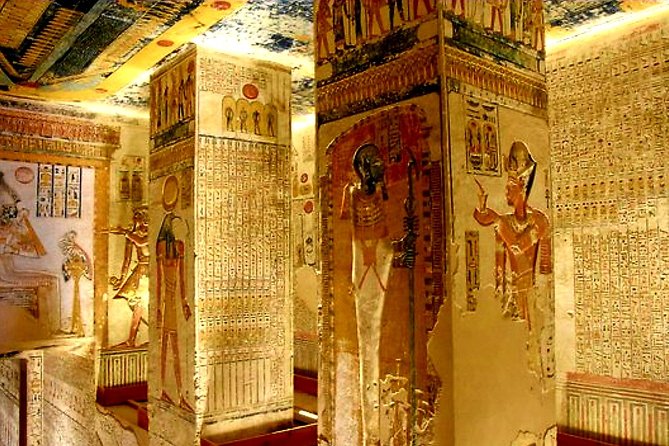
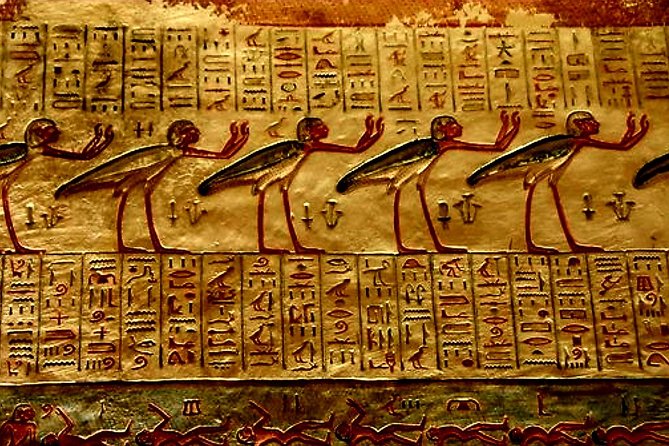
Ramesses III’s tomb, KV11, is known for its detailed painted reliefs and long religious texts. You may see scenes from the Litany of Ra and the Book of Gates, along with the king meeting the gods.
The unusual feature is found near the entrance, where side chambers contain scenes of foreign tribute and Aegean figures. These secular images offer a break from the usual funerary material. They show the wider world known to the Egyptians, not only the king’s journey after death.
Allow about 25 minutes for this tomb. Your guide may explain the wall scenes outside or at the entrance, since guides may not accompany you into every chamber.
A few more Luxor outings to price up
- Luxor Day Trip from Hurghada Small Group & Tutankhamun Tomb
★ 4.8 · 5,366 reviews - Hot Air Balloon Ride in Luxor Egypt with Transfers Included
★ 5.0 · 4,319 reviews - Luxor: Shared Full-Day Tour to Luxor West and East Banks
★ 4.5 · 1,812 reviews - Luxor: Hot Air Balloon Ride over Luxor Relics
★ 4.8 · 1,681 reviews
Ramesses IV and the blue and white burial chamber
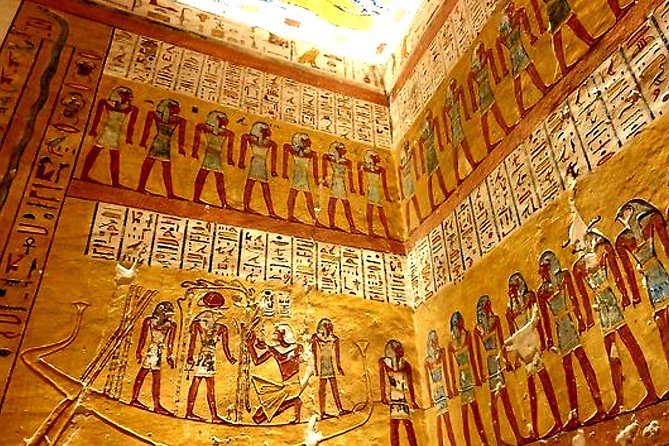
KV2, the tomb of Ramesses IV, is one of the most visually rewarding stops. Its walls carry texts from several funerary books, including the Book of the Dead, Book of Caverns, Book of the Heavens, Book of Amduat, and Book of the Night.
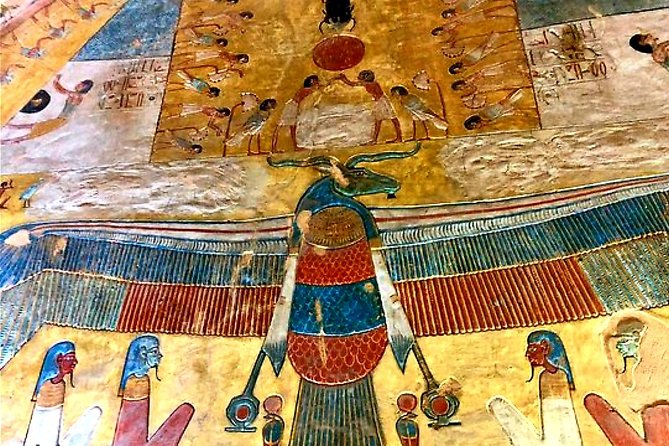
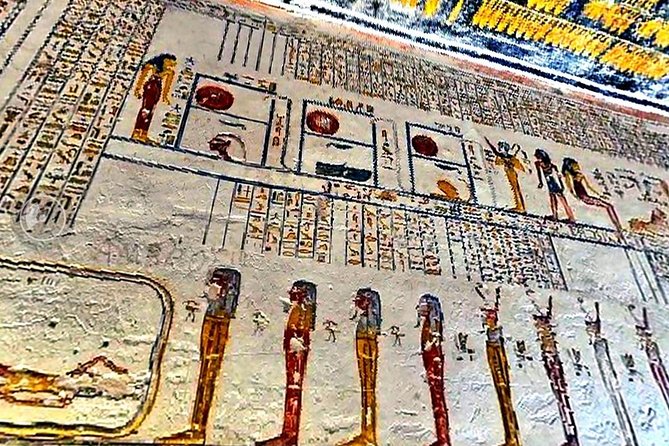
The burial chamber has blue and white decoration, a large rose-colored granite sarcophagus, and a ceiling showing the sky goddess Nut. I would give this tomb high priority if you care about color and decoration. The scheduled visit is about 25 minutes, which gives you time to notice the main scenes but may feel short if you want to inspect the hieroglyphs closely.
Merneptah and the scale of royal burial
Merneptah, son of Ramesses II and Queen Isis-Nofret, was buried in KV8. The tomb is associated with New Kingdom ideas about protection and the afterlife, including the role of Ptah, the creator god of Memphis and patron of craftsmen.
The route allots about 25 minutes. It is a useful stop for seeing how royal tomb design developed, but the valley portion can become a sequence of dark corridors if you rush. Take a moment at each entrance to note the different colors, ceilings, and proportions.
Ramesses IX and the ceiling of Nut
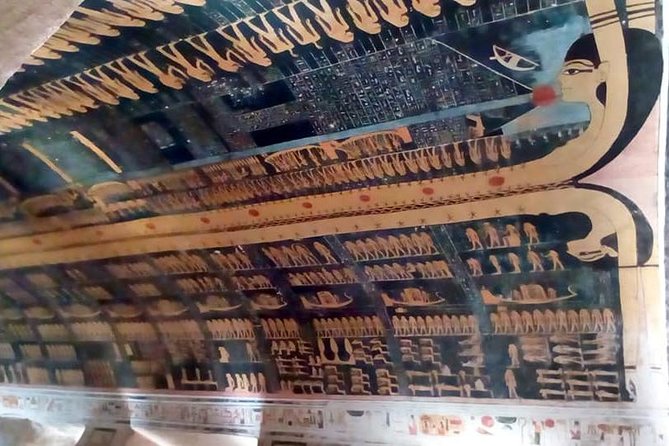
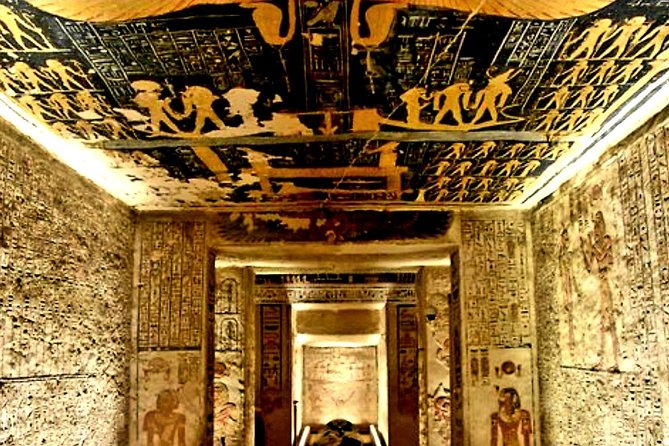
The separate description of Ramesses IX’s tomb highlights its strong colors and the ceiling image of Nut. She stretches across the sky, swallowing and giving birth to the sun, a clear symbol of death followed by renewal.
This is the sort of detail a good Egyptologist can bring to life. Without explanation, you may see a beautiful ceiling. With context, you understand why the image belongs above a burial chamber.
Horemheb and the limits of a packed schedule
Horemheb is included in the Valley of the Kings portion, though the supplied schedule does not give a separate duration for his tomb. His inclusion helps broaden the visit beyond the usual Tutankhamun focus.
The route may also be adjusted. One guest arranged a special request to visit Seti I and saw five tombs in total. That suggests the private format can help if you have a specific tomb in mind, but special access and extra fees should be settled before the morning begins.
Hatshepsut’s temple beneath the cliffs
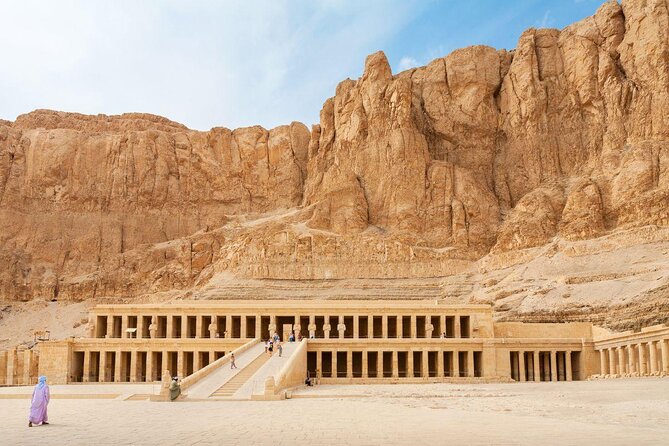
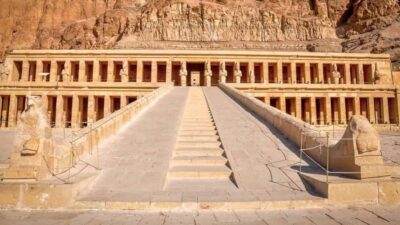
After the tombs, you spend about an hour at the Temple of Hatshepsut at Deir el-Bahari. This is a change of rhythm. Instead of narrow underground corridors, you get broad terraces, colonnades, and a monumental structure set against the Theban Mountain.
Hatshepsut was the only woman to rule Egypt as pharaoh, according to the tour description. Her reign was linked with peace, prosperity, and major building projects. She was an ancestor of Tutankhamun and belonged to the same broad royal line.
The temple’s reliefs present her divine birth and achievements. They also show how royal power was explained and defended in ancient Egypt. Your guide is most useful here, because the building’s political message is easy to miss if you only admire the terraces.
Plan for heat and exposure. The itinerary does not give detailed weather advice, but the temple is an open monumental site rather than an underground tomb. Comfortable clothing, water, and a willingness to walk are sensible choices.
One hour is a good allocation. You can see the main architectural arrangement and hear the story without spending the entire morning at one place.
The Valley of the Queens and the fragile beauty of Nefertari
The Valley of the Queens was known in ancient times as Ta-Set-Neferu, translated as The Place of Beauty or The Place of the Royal Children. Queens, princes, princesses, and other members of the royal family were buried here, rather than in the nearby Valley of the Kings.
The tour includes the valley and a short visit to the Tomb of Queen Titi, scheduled for about 10 minutes. Titi’s identity remains uncertain, which gives the small tomb an appealing sense of mystery. It is not the grandest chamber on the West Bank, but it offers a useful reminder that many royal burials belong to people less famous than the pharaohs.
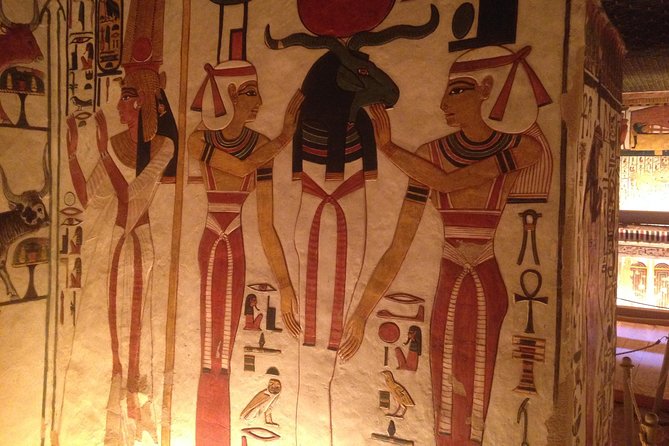
The major draw is Queen Nefertari’s tomb. The interior is celebrated for its superb painted scenes and strong colors. One enthusiastic account described it as looking freshly painted, and that is exactly why the extra ticket can be worthwhile.
But do not assume entry is guaranteed. A conservation order once closed Nefertari’s tomb on the same day it was due to be visited, after being open the previous day. Conditions can change quickly. Check at booking and again on the morning of the tour. If Nefertari is the main reason you are choosing this experience, ask what happens if the tomb is closed.
The cost is also significant. Nefertari’s ticket is separate, as are the other site admissions. Still, if the tomb is open and you care about ancient wall painting, this is likely the most worthwhile paid addition of the morning.
Colossi of Memnon, a quick final stop
The Colossi of Memnon take about 15 minutes and do not require an admission fee. These two stone statues rise more than 18 meters and once guarded the entrance to the huge mortuary temple of Amenhotep III.
The temple itself has mostly disappeared, leaving the statues to carry the story. Their connection to Amenhotep III also links this stop to Tutankhamun, since Amenhotep was Tutankhamun’s grandfather.
This is a short photo and orientation stop, not a major guided visit. It works well at the end, when your attention may be flagging after several tombs. From here, the driver returns you to your hotel in the air-conditioned vehicle.
What the $55 price really covers
At $55 per person, the tour is priced as a low-cost private experience rather than an all-inclusive sightseeing package. The price includes:
- A licensed Egyptologist guide
- Hotel pickup and drop-off
- Round-trip transport in a modern, air-conditioned vehicle
- A private tour for your own group
It does not include entrance tickets. That matters more here than on an ordinary West Bank visit because Tutankhamun’s tomb, Nefertari’s tomb, the Valley of the Kings, the Valley of the Queens, and Hatshepsut’s temple all involve admissions or ticket arrangements.
Think of the $55 as paying for the vehicle, guide, and organization. Then budget separately for the monuments. Several people specifically felt that paying extra for Tutankhamun and Nefertari was worth it, while another pointed out that the tickets can be expensive.
The offer of a hot-air-balloon ride before the tour is optional and not included. If you are considering it, confirm the price, timing, and whether it changes the pickup schedule. The listed tour itself begins at 8:00 am.
Timing, comfort, and how to make the day better
Five hours and 10 minutes is enough for a strong overview, but not for leisurely study at every stop. The itinerary lists many tombs, and several individual stops have only 20 to 25 minutes. You will need to accept a little speed.
I would set priorities in this order:
- Tutankhamun’s tomb and mummy
- Nefertari’s tomb, if open
- Ramesses IV or another especially well-preserved tomb
- Hatshepsut’s temple
- The remaining tombs and Colossi of Memnon
That order is not a command. It simply protects the sites most likely to matter to you if the schedule tightens.
Tell the guide what you want before leaving the hotel. The private format is most valuable when you use it. You might prefer fewer tombs with more explanation, or you might want to see as many burial chambers as possible.
The air-conditioned vehicle is a real comfort in Luxor. Pickup and drop-off at a central hotel also remove the need to arrange separate transport across the Nile and between the sites. Most people can participate, but the day still includes walking, steps, uneven surfaces, and underground spaces. The provided information does not give a detailed accessibility assessment, so ask the operator directly if mobility is a concern.
Guide quality and the right expectations
The strongest praise goes to the guides. Hassan was described as an excellent English speaker and a captivating storyteller. Roshdy was praised for patience, useful tips, and explanations of what to look for. Ragab was valued for his Egyptology training and ability to personalize the day. Abdul was described as an expert who explained the tombs in detail.
Those details matter. Luxor’s tombs are visually powerful, but much of their meaning is hidden in symbols and funerary texts. A good guide points out why Nut appears on a ceiling, what a tribute scene shows, and how a royal burial connects to ideas about rebirth.
The experience is not flawless for everyone. One poor account involved a guide attempting unscheduled stops and a disagreement that ended the tour early. You can reduce the chance of confusion by confirming the exact route, ticket costs, optional stops, and guide arrangements before setting off.
Should you book this private Luxor tour?
Book it if you want the West Bank’s most famous sites in one private morning, especially if Tutankhamun’s mummy and Nefertari’s painted tomb are high on your list. The included car, hotel pickup, and Egyptologist guide make $55 a useful base price, and the private format gives you a better chance of shaping the day around your interests.
Think twice if you want a slow archaeological study. The schedule is crowded, admission fees are separate, and Nefertari’s tomb can close with little notice. I would book only after confirming which tombs are open, what the tickets cost, and whether your guide will explain the monuments at the entrance or accompany you inside where permitted.
For most first-time visits to Luxor, this is a strong choice. Just treat the $55 as the beginning of the budget, not the final bill.
FAQ
What is included in the $55 tour price?
The price includes a licensed Egyptologist guide, hotel pickup and drop-off, round-trip transport in a modern air-conditioned vehicle, and a private tour for your group.
Are entrance tickets included?
No. Entrance tickets for the tombs and temple are not included in the tour price.
Can I see Tutankhamun’s mummy?
The tour offers the opportunity to enter Tutankhamun’s original tomb and see his mummy, but access remains subject to site conditions and current rules.
Is Queen Nefertari’s tomb included?
The tour offers access to the Valley of the Queens and the opportunity to visit Nefertari’s tomb. Her tomb requires a separate ticket and can close for conservation without advance notice.
What time does the tour start?
The stated start time is 8:00 am.
How long does the experience last?
The tour lasts approximately five hours and 10 minutes.
Is the tour private?
Yes. Only your group participates in the private tour.
Does the tour provide hotel pickup?
Yes. Pickup and drop-off are offered at centrally located hotels in Luxor.
Is the hot-air-balloon ride included?
No. A hot-air-balloon ride before the tour is an optional extra and is not included in the stated price.
Can I cancel for a full refund?
Yes, if you cancel at least 24 hours before the experience start time. Cancellations made less than 24 hours before the start time are not refundable, and late changes are not accepted.
Newly listed around Luxor
- Luxor Nile River Private Felucca Ride at Sunset★ 4.5 · 20 reviews
- Marvelous Luxor East and West Bank Private Tour with Lunch From Airport /Hotels★ 4.5 · 17 reviews
- Private tour : Sunset Felucca Ride in Luxor★ 5.0 · 16 reviews
- 3-Day Luxor Aswan and Abu Simbel Historical Sites Private Tour★ 5.0 · 34 reviews
- First impression of Luxor-Explore secrets of Luxor by horse carriage★ 5.0 · 50 reviews
- Nile cruise between Luxor and Aswan: Sail the best temples in Egypt★ 5.0 · 72 reviews
- Experience the Magic of a Luxor Sunrise Hot Air Balloon Ride★ 5.0 · 17 reviews
- 5 Days 4 Nights from Luxor to Aswan on Gentle Breeze Dahabyia★ 4.5 · 24 reviews
Valley of the Kings Tours, compared.
Luxor Valley of the Kings & Tutankhamun Tomb Trip
Read our review →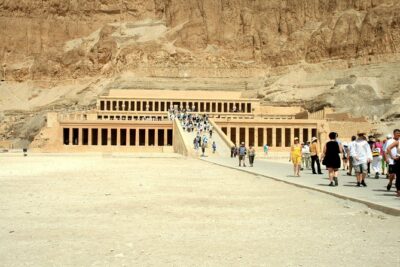
Small group Hurghada to Luxor, Valley of the Kings by Van
Read our review →Luxor Day Tour: Valley of Kings & Queens & Hatchepsut Temples
Read our review →Valley of the Kings and Hatshepsut Temple Day Tour
Read our review →
Luxor Tour with Valley of Kings, Karnak & Tut Tomb
Read our review →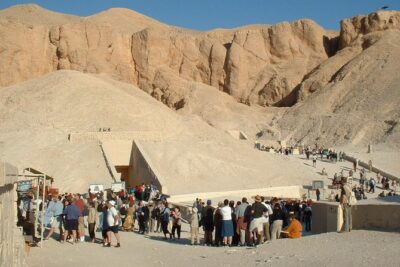
Valley of Kings, Hatchepsut Temple ,Karnak & Luxor-DayTour
Read our review →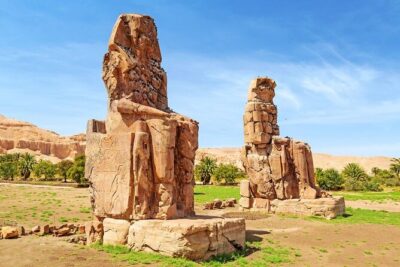
Full Day Tour of Luxor West Bank Temples and Tombs (Private)
Read our review →
Small Group Excursion to Luxor Valley of the Kings from Hurghada
Read our review →Browse the lists this tour appears in