
Reviewed · VALLEY OF THE KINGS TOURS
Full Day Tour of Luxor West Bank Temples and Tombs (Private)
Ancient tombs reward a slower look. This private Luxor tour gives you a full day on the Nile’s west bank, with an Egyptologist guide, a private air-conditioned vehicle, hotel pickup, and six major sites. I especially like the private format, which lets you ask questions and adjust the pace, and the chance to visit quieter places such as Deir el-Medina and Medinet Habu alongside the famous Valley of the Kings.
The price begins at $20 per person, which is excellent value for transport and a private guide, but it is not the final cost if you add entrance tickets or lunch. The main thing to consider is the packed schedule. Seven to ten hours is enough to see a lot, but you will want sensible shoes, water, and a clear idea of which tombs matter most to you.
In This Review
- Five things to know before you book
- Why a private day on the West Bank makes sense
- Valley of the Kings: two hours among royal tombs
- Hatshepsut Temple and the cliffs of Deir el-Bahari
- Valley of the Queens: a different royal burial ground
- Deir el-Medina, where tomb builders lived
- Medinet Habu, the day’s powerful surprise
- Ten minutes at the Colossi of Memnon
- Guides, drivers, and the value of personal attention
- Price, tickets, lunch, and possible extra costs
- How to prepare for this long Luxor outing
- Who should book this West Bank tour?
- Should you book it?
- FAQ
- How long does the private West Bank tour last?
- What sites are included in the route?
- Is hotel pickup included?
- Is transportation private?
- Is an Egyptologist guide included?
- Are entrance fees included in the $20 price?
- Is lunch included?
- Is airport pickup available?
- Can I cancel for a full refund?
Five things to know before you book
- The day covers six major West Bank sites, from the Valley of the Kings to the Colossi of Memnon.
- Your private Egyptologist guide can shape the visit, explain the monuments, and answer questions without a large group slowing things down.
- Entrance fees are separate, including the Valley of the Kings ticket and its allowance for three tombs.
- Deir el-Medina and Medinet Habu may be the day’s quiet highlights, with detailed decoration and fewer crowds than the headline sites.
- Lunch depends on the option you choose, so check the exact package before paying.
- The vehicle, hotel pickup, and bottled water matter in Luxor’s heat, especially on a long day across the West Bank.
Why a private day on the West Bank makes sense
Luxor’s ancient heart is split by the Nile. The East Bank held temples connected with worship and public ceremony, while the West Bank became the great burial ground of Thebes. The area is spread out, and the sites do not form one neat walking route.
That geography makes a private vehicle useful. You are not trying to piece together taxis between valleys, and you can move from one site to the next in an air-conditioned van or car. Several people specifically praised punctual pickup, careful driving, and spacious vehicles. Drivers named in the feedback include Mustafa, Ahmed, Ramesses, and Abanob, though your assigned driver will depend on the date and booking.
A private guide also changes the feel of the day. At the Valley of the Kings, for instance, you need to decide how to use the tomb allowance and whether any tombs cost extra. A guide can help you choose instead of leaving you to guess at the entrance.
The tour is advertised at about seven to ten hours. The listed visits add up to roughly six and a half hours before driving, ticket lines, lunch, and photo stops. Plan on a full day, not a quick morning outing.
More West Bank and Valley of the Kings days:
- Hurghada: Luxor Valley of the Kings & Tutankhamun Tomb Trip
★ 4.7 · 13,208 reviews - Luxor Day Tour: Valley of Kings & Queens & Hatchepsut Temples
★ 5.0 · 1,496 reviews - Luxor: Valley of the Kings and Hatshepsut Temple Day Tour
★ 4.4 · 1,404 reviews
Valley of the Kings: two hours among royal tombs
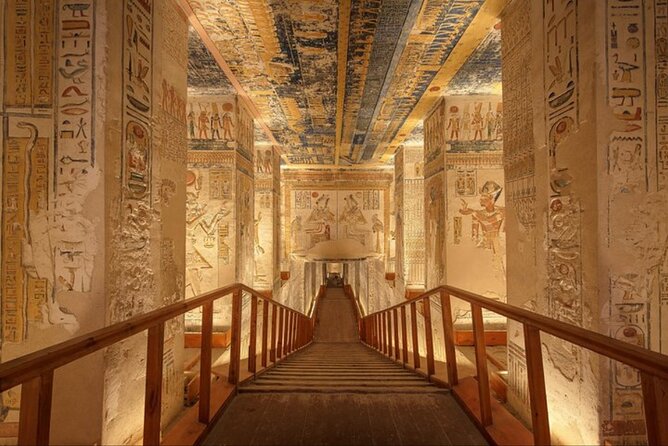
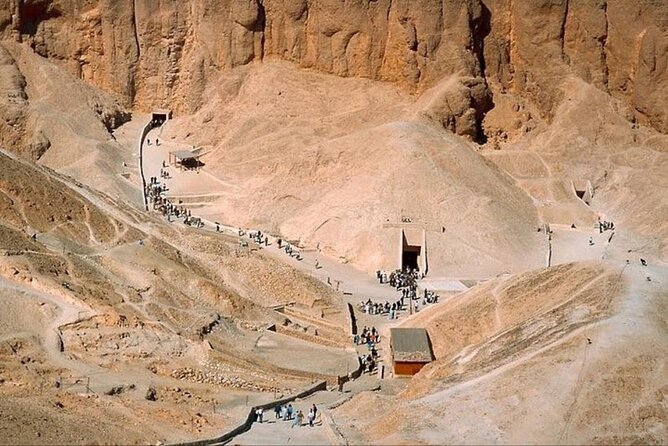
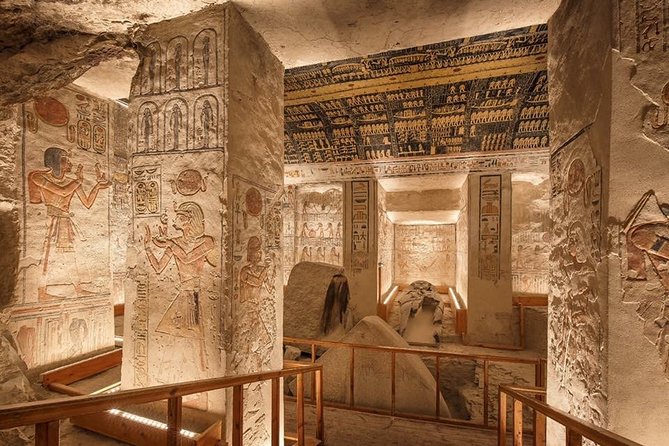
The Valley of the Kings is the tour’s headline stop. Hidden in a dry valley on the West Bank, it served as the burial ground for pharaohs during Egypt’s New Kingdom. The tombs were cut into the rock rather than built as large pyramids, with long corridors leading down toward burial chambers.
You receive about two hours here, which is a useful amount of time for a first visit. The entrance ticket includes access to three tombs under the stated Ministry of Tourism instruction. Some tombs may require an additional ticket, so you should decide in advance if there is a particular burial place you want to see.
Do not assume the most famous name is automatically the best choice on the day. Openings can change, and the guide can advise you about the available tombs. The guide’s role is especially helpful here because the paintings are easier to understand when you know what the figures, symbols, and scenes represent.
The drawback is heat and walking. The valley is exposed, and tomb entrances involve uneven ground and steps. Most people can take part, but you should be comfortable walking through archaeological sites for extended periods.
Hatshepsut Temple and the cliffs of Deir el-Bahari
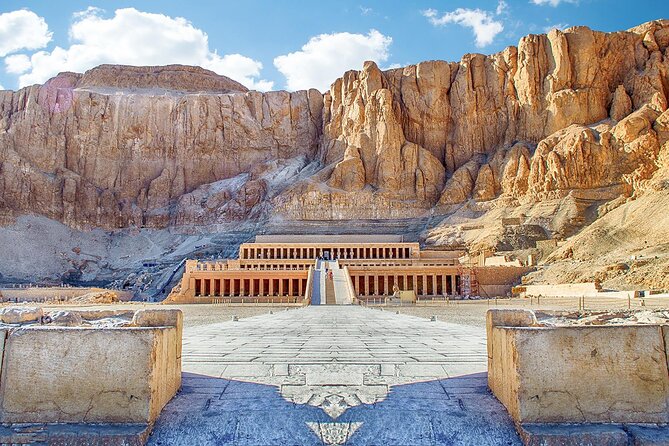
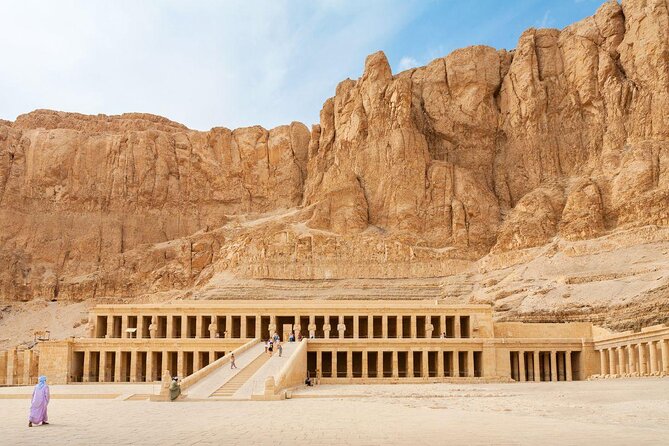
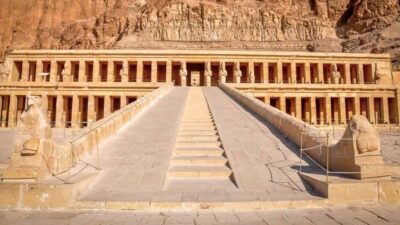
The Temple of Hatshepsut gives the day a sharp change of mood. Instead of narrow underground corridors, you get broad terraces set against steep cliffs at Deir el-Bahari. The temple rises about 97 feet, or 30 meters, and its unusual shape follows the natural setting.
Hatshepsut ruled as pharaoh and is remembered as one of ancient Egypt’s most important queens. Her mortuary temple was built in a place already linked with royal funerary architecture. Around 2050 BC, Mentuhotep II had established a sloping, terrace-shaped temple here, and Hatshepsut’s builders worked within that powerful setting.
The planned visit lasts about an hour. That is enough for an introduction and photographs, but you may want to ask your guide for a little extra time if the temple is a priority. One advantage of a private tour is the ability to say so.
This is also a good place to pay attention to the contrast between architecture and rock. The terraces draw your eye upward, while the cliffs close the space behind the monument. I find that the site makes more sense when the guide explains why the temple looks so different from the tombs visited earlier.
Valley of the Queens: a different royal burial ground
The Valley of the Queens was known in ancient times as Ta-Set-Neferu, often translated as the place of beauty. It was used mainly for the wives of pharaohs and other members of the royal family, while the pharaohs themselves were generally buried in the Valley of the Kings.
The scheduled visit lasts about 90 minutes. That gives you time to see the area and visit the tombs that are open under the ticket arrangement. As with the Valley of the Kings, entrance charges are not part of the basic tour price.
One important warning concerns Queen Nefertari’s tomb. Its status can change, and it has been closed at times. Do not book this day solely on the assumption that you will enter it. Ask about current access before you go, and treat any opening as a bonus rather than a guarantee.
The Valley of the Queens adds useful context. It prevents the West Bank from becoming a single story about kings and military rulers. You see how royal burial customs extended to queens and other high-ranking people.
A few more Luxor outings to price up
- Luxor: Shared Full-Day Tour to Luxor West and East Banks
★ 4.5 · 1,812 reviews - Full Day Tour to East and West Banks of Luxor
★ 5.0 · 1,449 reviews - Luxor : Full Day Tour to Luxor West and East Banks & Lunch
★ 5.0 · 870 reviews - Private Full-Day Luxor Highlights East and West Banks
★ 5.0 · 663 reviews
Deir el-Medina, where tomb builders lived
Deir el-Medina is one of the most revealing stops because it brings the workers into the story. This ancient village housed the artisans who built and decorated tombs in the Valley of the Kings during the 18th to 20th Dynasties.
You have about an hour here. The site helps explain how the royal tombs were made. Instead of only seeing the finished burial chambers, you get a sense of the community of craftsmen behind them.
Several people singled out Deir el-Medina as a favorite, partly because it can feel less crowded and because its decoration remains remarkably detailed. The smaller scale also gives the day a welcome change after the major royal monuments.
This stop rewards an attentive guide. Ask about daily work, the village, and the relationship between the artisans and the royal burial grounds. The program description does not provide more detailed village information, so the quality of your guide will shape how much meaning you take from the visit.
Medinet Habu, the day’s powerful surprise
The Temple of Ramesses III at Medinet Habu is often the site that changes people’s expectations. It was an important New Kingdom temple, and its walls preserve strong reliefs and architectural details.
The planned visit is one hour. That is enough to appreciate the scale and decoration, though anyone fascinated by military scenes, temple reliefs, or Ramesses III may want to ask for more time.
Medinet Habu is valuable because it feels different from Hatshepsut’s temple. Hatshepsut’s monument is open and terrace-based, shaped by cliffs and ceremonial design. Medinet Habu has a more fortified, forceful character. Seeing both in one day makes the contrasts easier to grasp.
The temple also gives you a break from the most famous stops. Several accounts praise it, along with Deir el-Medina, for its well-preserved detail and lower crowd levels. Crowd conditions vary, but the two sites deserve more than a rushed glance.
Ten minutes at the Colossi of Memnon
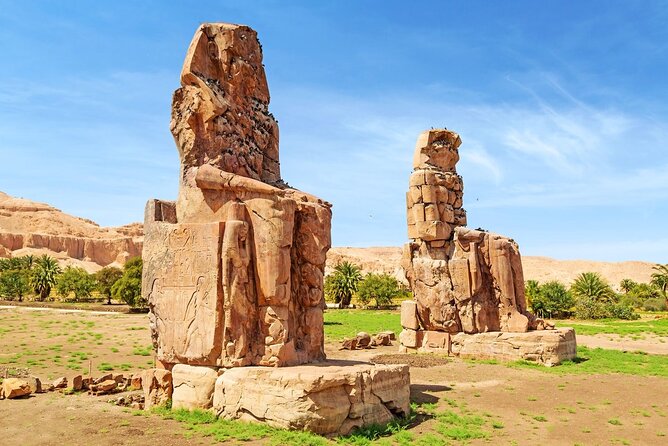
The Colossi of Memnon are two huge stone statues of Pharaoh Amenhotep III. They sit in front of the ruined mortuary temple of Amenhotep III, once the largest temple complex in the Theban Necropolis.
The stop lasts only about ten minutes, and admission is free. That makes it a quick photo stop rather than a full monument visit.
The statues are still worth seeing. Their size gives you a strong sense of how grand the lost temple must have been. Your guide can explain the connection between the figures, Amenhotep III, and the ruined complex behind them.
Because the stop is brief, have your camera ready and do not expect a long exploration. It works well at the end of the West Bank route as a final look at a monument that has survived while much of its original setting disappeared.
Guides, drivers, and the value of personal attention
The strongest feature of this tour is the human service. Guide names praised in the supplied feedback include Hany Yessen, Sayed Gamal, Hassan, Beshoy, Besho, Ahmed Emam, and Emad. Their styles differ, but the repeated strengths are clear: historical explanations, friendly communication, help with photographs, and freedom to explore after the main talk.
That last point matters if you are traveling with children or prefer time alone. One account describes a guide who explained the sites, then allowed the family time for photos and selfies. Another praised the way the guide adapted the day around the group’s interests.
The drivers also receive strong marks for punctuality, smooth driving, and polite service. In Luxor, that is not a minor detail. A careful driver and a cool vehicle make a long day much easier.
Still, guide quality can vary from person to person. The tour promises a private Egyptologist guide, but it does not promise one particular named guide. If a specific guide is important to you, ask the operator before booking, without assuming the request can be guaranteed.
Price, tickets, lunch, and possible extra costs
At $20 per person, the starting price is unusually low for a private vehicle and private Egyptologist guide. The value is strongest for two or more people sharing the vehicle, since you receive private service without joining a large coach group.
The price needs careful reading. Entrance fees to all listed sites are excluded from the base option. The Valley of the Kings ticket includes three tombs according to the stated Ministry of Tourism instruction, but certain tombs can cost extra. Queen Nefertari’s tomb, when open, may not be covered by the standard ticket.
Lunch is also separate unless you select the option described as Car plus Guide plus Entry plus Lunch. A local restaurant meal is included with that package, and feedback describes generous Egyptian food. Compare the package prices before booking so the low headline figure does not surprise you later.
The program lists optional tipping, meaning it is not required. Airport pickup costs an additional $10. The advertised inclusions do not list a shop visit or a Banana Island dinner, so ask exactly what your chosen package includes if you want a strictly focused archaeological day.
How to prepare for this long Luxor outing
Start by choosing your priorities. Six sites in one day is a lot, and the two valleys alone can absorb your attention. If you care most about tomb paintings, tell the guide early. If temples matter more, ask for extra time at Hatshepsut or Medinet Habu.
Bring water, though bottled water is provided in the vehicle. Wear practical shoes and prepare for sun, uneven paths, and repeated walking in and out of tombs. The air-conditioned vehicle gives you useful relief between sites.
Use the private format actively. Ask questions, request photo time, and say when you need a short pause. The schedule is intense, but several accounts describe guides who allowed extra time once their explanations were finished.
The tour confirms at booking and offers hotel pickup and return in Luxor. Public transportation is nearby, but you do not need to rely on it for the main excursion. Most people can participate, though the amount of walking makes this a poor choice for anyone seeking a very relaxed day.
Who should book this West Bank tour?
I would choose this tour if you have only one day for Luxor’s West Bank and want more than the Valley of the Kings. It suits couples, families, and small groups who value a private vehicle, personal questions, and a flexible pace.
It is also a good match for travelers watching their budget, provided they understand that tickets and lunch may add to the $20 starting price. The day delivers real value through transport, a guide, and access to several major sites in one organized route.
I would hesitate if you dislike full schedules or want to linger at one monument for hours. The seven to ten hour duration is not an estimate to ignore. It is a full archaeological day, with heat, walking, and several stops.
Should you book it?
Book it if you want a broad, efficient introduction to Luxor’s West Bank, especially if Deir el-Medina and Medinet Habu appeal to you as much as the famous valleys. The high 4.9 rating from 722 ratings and 99 percent recommendation fit the strongest pattern here: punctual pickup, careful drivers, friendly guides, and a great deal of history for the time and money.
Before paying, confirm three things: the total cost with entrance tickets, which lunch package you are selecting, and the current status of the tombs you most want to enter. With those points clear, this is a strong private day for seeing the West Bank without wasting time on transport.
FAQ
How long does the private West Bank tour last?
The tour lasts approximately seven to ten hours, depending on transfers, site time, lunch, and the pace of your private group.
What sites are included in the route?
The route visits the Valley of the Kings, Temple of Hatshepsut at Deir el-Bahari, Valley of the Queens, Valley of the Artisans at Deir el-Medina, Medinet Habu, and the Colossi of Memnon.
Is hotel pickup included?
Yes. Pickup and return from your hotel in Luxor are included.
Is transportation private?
Yes. Transfers are provided in a private air-conditioned vehicle, and only your group participates in the activity.
Is an Egyptologist guide included?
Yes. The tour includes a private Egyptologist guide.
Are entrance fees included in the $20 price?
No. Entrance fees to the listed archaeological sites are excluded from the base price. The Valley of the Kings ticket includes three tombs according to the stated Ministry of Tourism instruction, while some tombs may require additional payment.
Is lunch included?
Lunch is included only when you choose the package described as Car plus Guide plus Entry plus Lunch. The basic tour price does not include lunch.
Is airport pickup available?
Yes, airport pickup is available for an additional $10.
Can I cancel for a full refund?
You can cancel at least 24 hours before the experience start time for a full refund. Cancellations or changes made less than 24 hours before the start time are not accepted for a refund. If poor weather cancels the tour, you will be offered another date or a full refund.
Newly listed around Luxor
- Luxor Nile River Private Felucca Ride at Sunset★ 4.5 · 20 reviews
- Marvelous Luxor East and West Bank Private Tour with Lunch From Airport /Hotels★ 4.5 · 17 reviews
- Private tour : Sunset Felucca Ride in Luxor★ 5.0 · 16 reviews
- 3-Day Luxor Aswan and Abu Simbel Historical Sites Private Tour★ 5.0 · 34 reviews
- First impression of Luxor-Explore secrets of Luxor by horse carriage★ 5.0 · 50 reviews
- Nile cruise between Luxor and Aswan: Sail the best temples in Egypt★ 5.0 · 72 reviews
- Experience the Magic of a Luxor Sunrise Hot Air Balloon Ride★ 5.0 · 17 reviews
- 5 Days 4 Nights from Luxor to Aswan on Gentle Breeze Dahabyia★ 4.5 · 24 reviews
Valley of the Kings Tours, compared.
Luxor Valley of the Kings & Tutankhamun Tomb Trip
Read our review →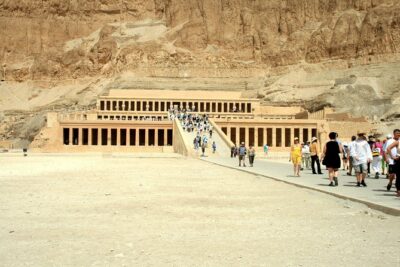
Small group Hurghada to Luxor, Valley of the Kings by Van
Read our review →Luxor Day Tour: Valley of Kings & Queens & Hatchepsut Temples
Read our review →Valley of the Kings and Hatshepsut Temple Day Tour
Read our review →
Luxor Tour with Valley of Kings, Karnak & Tut Tomb
Read our review →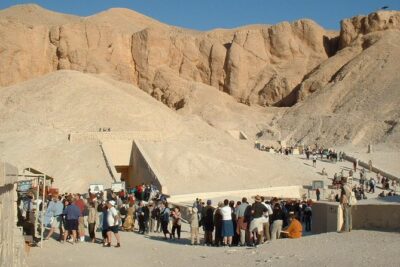
Valley of Kings, Hatchepsut Temple ,Karnak & Luxor-DayTour
Read our review →
Small Group Excursion to Luxor Valley of the Kings from Hurghada
Read our review →
Valley of Kings Hatshepsut & Karnak Luxor Day Trip
Read our review →Browse the lists this tour appears in