
Reviewed · LUXOR TOURS
East Bank in Luxor Day Tour Karnak temple and Luxor Temple
Ancient Egypt begins with two great temples. This private East Bank tour gives you a simple way to see Karnak and Luxor Temple in about three hours, with hotel or Nile cruise pickup and an air-conditioned car. I like the private format, which keeps the outing focused on your group, and I like the easy pickup and drop-off. The main catch is that entry tickets and an Egyptologist guide cost extra.
At $16 per person, this is a strong transport-and-sightseeing package if you are traveling with family or friends. You get bottled water, private transfers, and a driver, while the guide remains optional. Check the final price carefully, since tickets, tipping, and language-specific guiding are not included.
In This Review
- Key points at a glance
- Why the East Bank makes a smart half-day plan
- Karnak Temple and its 134 columns
- Luxor Temple and five layers of history
- Private transport and pickup details
- What the optional guide changes
- Is $16 per person good value?
- Who should book this East Bank tour?
- Booking and cancellation points to remember
- Should you book it?
- FAQ
- How long does the East Bank tour last?
- Are hotel and Nile cruise pickups available?
- Is the tour private?
- Are temple entry tickets included?
- Is an Egyptologist guide included?
- What is the cancellation policy?
Key points at a glance
- Karnak takes about two hours: You have time to see the huge columned hall, obelisks, and major religious areas without rushing through the site.
- Luxor Temple adds another layer: Its stones reflect ancient Egyptian, Greek, Roman, Christian, and Islamic periods.
- Your group gets a private car: Pickup is available from a Luxor hotel or Nile cruise, with transfers in a modern air-conditioned vehicle.
- Guiding is optional: An English-speaking Egyptology guide can be arranged, while French, German, Italian, and Spanish requests are also accepted.
- The price is low for private transport: At $16 per person, the value improves when several people share the booking.
- Cancellation is flexible: You can receive a full refund if you cancel at least 24 hours before the start time.
Why the East Bank makes a smart half-day plan
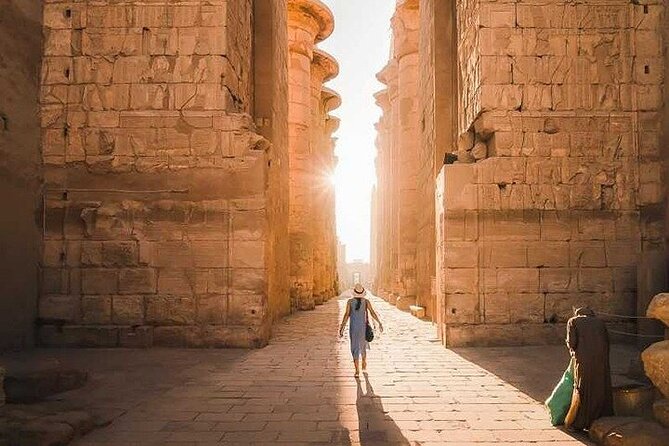
Luxor is divided by the Nile, and the East Bank is where two of the city’s most important temples sit. Karnak and Luxor Temple are close enough to visit in one outing, yet each gives you a different view of ancient Thebes.
I like this tour for travelers who want a clean, uncomplicated plan. You do not need to arrange a taxi between the sites, bargain with a driver, or work out how to return to your hotel or ship. The operator collects you, takes you to both temples, and brings you back to the starting point.
The tour lasts about three hours. That is enough for a useful introduction, but not enough for a slow archaeological study. If you want to examine every inscription or spend long periods taking photographs, you may find the schedule tight. For a first look at the East Bank, though, the timing is sensible.
The activity is private, so only your own group participates. That matters in Luxor, where a small group can move more easily through large temple grounds. It also lets you ask questions at your own pace, especially if you add the optional guide.
A few more Luxor outings to price up
- Hurghada: Luxor Valley of the Kings & Tutankhamun Tomb Trip
★ 4.7 · 13,208 reviews - Luxor Day Trip from Hurghada Small Group & Tutankhamun Tomb
★ 4.8 · 5,366 reviews - Hot Air Balloon Ride in Luxor Egypt with Transfers Included
★ 5.0 · 4,319 reviews
Karnak Temple and its 134 columns
The first stop is Karnak Temple, with roughly two hours set aside for the visit. This is the larger and more sprawling of the two temple complexes, and it deserves the longer time slot.
Karnak was dedicated to Amun-Ra, along with his wife Mut and their son Khonsu. These three deities formed the Theban religious group, and the complex grew over many centuries as rulers added gateways, courtyards, halls, statues, and inscriptions.
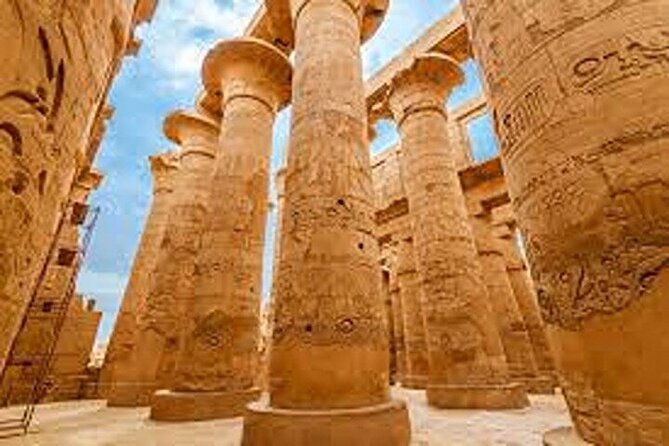
The most famous sight is the Great Hypostyle Hall. Its 134 columns create a forest of stone, with the largest columns rising high above you. Even without a guide, the scale is easy to grasp. With an Egyptology guide, you can better understand how the hall served religious ceremonies and how the carvings connect the king with the gods.
The towering obelisks are another major feature. They were carved from granite and raised as symbols linked to the sun god. Their height and placement help you see how ancient builders used stone, space, and sunlight to create a sense of power.
You will also see the Holy of Holies, the most sacred inner area of the temple. This is where the religious purpose of Karnak becomes clearer. It was not built as a single monument for tourists to admire. It was a working center of worship, ceremony, and royal authority.
The description of the tour gives particular attention to the temple’s towering structures and its columned hall. That is useful because Karnak can feel confusing at first. There is a great deal to see, and a guide can help separate the main sights from the less important corners.
The guide is optional, so you need to decide what kind of visit you want. If you already know the basics of Egyptian religion and architecture, the private car and time at the site may be enough. If you want the stories behind Amun-Ra, Mut, Khonsu, the kings, and the temple additions, paying for an Egyptologist guide will likely make the visit more rewarding.
Admission is not included. You should treat the advertised price as the cost of the private service and transport, not as an all-inclusive temple ticket.
Luxor Temple and five layers of history
After Karnak, the tour continues to Luxor Temple for about one hour. This temple is smaller and more compact, so the shorter visit works well. It also has a different character from Karnak.
Luxor Temple began under Amenhotep III in the Eighteenth Dynasty during the New Kingdom. Ramesses II later completed major parts of it during the Nineteenth Dynasty. Ramesses II ruled Egypt for about 67 years and is one of the best-known pharaohs connected with the site.
The temple was dedicated to Amun-Ra and connected with Mut and Khonsu, just as Karnak was. This shared religious focus helps you see the two sites as parts of the same sacred center rather than as unrelated monuments.
One of the first features you are likely to notice is the obelisk of Ramesses II near the entrance. It gives the approach a strong sense of ceremony and scale. From there, the temple opens into courts, columns, and decorated areas that show how royal power was presented through stone.
Luxor Temple also carries evidence of later periods. The complex includes traces from ancient Egyptian, Greek, Roman, Christian, and Islamic use. That makes it especially useful for understanding how sacred places were reused and changed over time.
You may see Roman columns and Greek inscriptions alongside older Egyptian carvings. Christian and Islamic connections are also part of the site’s long story. The result is not one perfectly preserved moment, but a place shaped by many centuries of worship and adaptation.
I like this stop because it gives you historical variety after the grand scale of Karnak. Karnak is about size and religious power. Luxor Temple is about layers, reuse, and the way one important place can continue to matter long after its first builders are gone.
The one-hour schedule means you should keep moving. Focus on the entrance, obelisk, major courts, columns, and the later additions. If you become absorbed in every carved figure, you may need to choose between photography and detailed explanation.
Private transport and pickup details
Pickup is offered from a hotel or Nile cruise in Luxor. The meeting area is listed as Luxor Governorate, and the activity ends back at the meeting point. That return transfer is useful if you are staying in town or using Luxor as a stop on a Nile cruise.
All transfers use a private, air-conditioned vehicle described as a modern, latest-model car. In Luxor’s warm climate, air conditioning is more than a nice extra. It gives you a cool break between temple visits and makes the short drives more comfortable.
The driver is part of the practical strength of the experience. The service includes a licensed tour representative from Adam’s Tours, and the available feedback gives strong marks to punctual pickup, the air-conditioned car, and friendly service. One booking included plenty of drinks to choose from, while bottled water is listed as part of the package.
The driver may be the main person accompanying you if you do not add a guide. That setup works well if your priority is transportation and independent time at the temples. It is less suitable if you expect a full historical lecture as part of the base price.
Same base, a completely different sort of day:
- Luxor: Shared Full-Day Tour to Luxor West and East Banks
★ 4.5 · 1,812 reviews - Luxor: Hot Air Balloon Ride over Luxor Relics
★ 4.8 · 1,681 reviews - Luxor Day Tour: Valley of Kings & Queens & Hatchepsut Temples
★ 5.0 · 1,496 reviews - Full Day Tour to East and West Banks of Luxor
★ 5.0 · 1,449 reviews
What the optional guide changes
An English-speaking Egyptologist guide is optional. French, German, Italian, and Spanish guides can also be requested. The exact language should be confirmed before booking, since the guide is not automatically included.
This choice affects the whole feel of the visit. With a guide, you can ask why Amun-Ra mattered, how the temples relate to Theban religion, and what the carvings say about kingship. You can also get help identifying Greek, Roman, Christian, and Islamic traces at Luxor Temple.
Without a guide, you still receive private transport and time to explore. You will need to read signs, use your own guidebook, or simply enjoy the scale and decoration. That may be perfectly fine for a repeat visit or for someone who prefers to wander without a set explanation.
The available feedback gives the guide option high praise for detailed knowledge of ancient Egypt. The driver was also described as arriving on time, with the air conditioning working well. Those are small details, but they matter during a short tour. A late start could reduce your time inside both temples, so punctual pickup is worth confirming.
Is $16 per person good value?
At $16 per person, this is inexpensive for a private outing with hotel or port pickup, return transport, bottled water, and a private group arrangement. The value is particularly good if you are splitting the cost with several people.
You should not compare the price with a fully guided tour until you add the extras. Entry tickets are not included. The Egyptologist guide is also optional and costs more, as do requests for a French, German, Italian, or Spanish guide. Tipping is separate as well.
For a couple, family, or group of friends, the price can work well because you are paying for a private car rather than a seat on a large shared bus. The service is also useful if you want a simple transfer plan from a Nile cruise.
For a solo visitor, the per-person price may still be reasonable, but the value is less dramatic. You are paying for privacy and convenience, not just admission. If your main goal is the lowest possible cost, a shared excursion could be cheaper, though it would not offer the same private format.
A good booking question is: what is the total cost after temple tickets and the guide? Once you have that figure, you can compare the tour fairly with other East Bank options.
Who should book this East Bank tour?
I would recommend it to you if you want to see the two major East Bank temples without arranging every transfer yourself. It suits first-time visitors, families, Nile cruise passengers, and small groups that value a private vehicle.
It is also a good fit if you want to choose your level of explanation. You can keep the base service simple, or add an Egyptology guide for more context. The language choices make it useful for groups that do not want an English-only explanation.
You may want something else if you prefer a long, slow temple visit. Three hours is a practical introduction, not a full archaeological day. The one-hour stop at Luxor Temple is enough to see the key areas, but it may not satisfy you if you like to linger at every inscription.
You should also budget for admission tickets and tipping. The low advertised price is attractive, but it does not cover those costs.
Booking and cancellation points to remember
Confirmation is provided at the time of booking. Public transportation is nearby, and most people can participate. The activity is private, with only your own group taking part.
Free cancellation applies if you cancel at least 24 hours before the experience begins. A cancellation inside that 24-hour window is not refunded, and changes made during that period are not accepted. The cut-off follows local Luxor time.
Because the tour is often booked about 14 days in advance, it makes sense to reserve early if the timing matters to your hotel or cruise schedule. Confirm your pickup point, guide language, and the separate cost of tickets before the day arrives.
Should you book it?
Book this tour if you want private transport, a short schedule, and both major East Bank temples in one outing. The strongest points are the air-conditioned car, hotel or cruise pickup, private group format, bottled water, and the choice to add a guide.
The tour gives you a solid first look at Karnak’s immense column hall, obelisks, and sacred spaces, then follows with Luxor Temple’s royal monuments and five historical layers. Just remember that tickets and guiding are extra.
For a small group that values ease and a clear three-hour plan, this is good value at $16 per person before added costs. For a visitor who wants extensive archaeological instruction or several unhurried hours at each site, choose a longer guided option instead.
FAQ
How long does the East Bank tour last?
The tour lasts approximately three hours, with about two hours at Karnak Temple and one hour at Luxor Temple.
Are hotel and Nile cruise pickups available?
Yes. Pickup and drop-off are offered from a hotel or Nile cruise in Luxor, and the activity ends back at the meeting point.
Is the tour private?
Yes. Only your group participates, and all transfers use a private air-conditioned vehicle.
Are temple entry tickets included?
No. Entry tickets are not included in the tour price.
Is an Egyptologist guide included?
No. An English-speaking Egyptologist guide is optional. French, German, Italian, and Spanish guides can be requested.
What is the cancellation policy?
You receive a full refund if you cancel at least 24 hours before the experience start time. Cancellations or changes made less than 24 hours before the start time are not accepted for a refund.
Newly listed around Luxor
- Luxor Nile River Private Felucca Ride at Sunset★ 4.5 · 20 reviews
- Marvelous Luxor East and West Bank Private Tour with Lunch From Airport /Hotels★ 4.5 · 17 reviews
- Private tour : Sunset Felucca Ride in Luxor★ 5.0 · 16 reviews
- 3-Day Luxor Aswan and Abu Simbel Historical Sites Private Tour★ 5.0 · 34 reviews
- First impression of Luxor-Explore secrets of Luxor by horse carriage★ 5.0 · 50 reviews
- Nile cruise between Luxor and Aswan: Sail the best temples in Egypt★ 5.0 · 72 reviews
- Experience the Magic of a Luxor Sunrise Hot Air Balloon Ride★ 5.0 · 17 reviews
- 5 Days 4 Nights from Luxor to Aswan on Gentle Breeze Dahabyia★ 4.5 · 24 reviews
Luxor Tours, compared.
Luxor Valley of the Kings & Tutankhamun Tomb Trip
Read our review →
Luxor Day Trip from Hurghada Small Group & Tutankhamun Tomb
Read our review →
Hot Air Balloon Ride in Luxor Egypt with Transfers Included
Read our review →Shared Full-Day Tour to Luxor West and East Banks
Read our review →
Luxor Day Tour: Valley of Kings & Queens & Hatchepsut Temples
Read our review →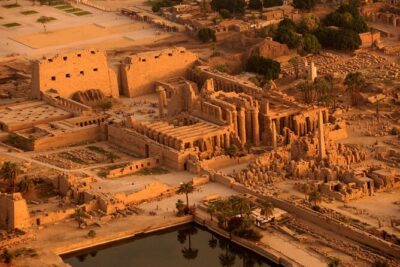
Full Day Tour to East and West Banks of Luxor
Read our review →Valley of the Kings and Hatshepsut Temple Day Tour
Read our review →Browse the lists this tour appears in