
Reviewed · ASWAN TOURS
Top Day Tour To Luxor From Aswan
Luxor packs Egypt’s greatest monuments into one long day. This private trip from Aswan takes you across the Nile Valley to ancient Thebes, with an Egyptologist guide leading you through the Valley of the Kings, Hatshepsut’s temple, Karnak, and Luxor Temple. I like the private vehicle and hotel pickup, which make the long journey simpler, and I like that the entrance fees and bottled water are included.
I also appreciate the quality of the guiding. Ayman, Ahmed, Ashraf, Ghada Khalaf, Mohamed Hashimi, and others are praised for clear explanations, patience, humor, and help with family photos. The main drawback is the length: about 13 hours, with roughly 280 kilometers each way between Aswan and Luxor. This is a serious day out, not a relaxed sightseeing stroll.
In This Review
- Key Points Before You Book
- Why Make the Long Trip From Aswan?
- The Drive Through the Nile Valley
- Valley of the Kings: Tombs Cut Into the Hills
- Hatshepsut’s Temple and the Story of a Female Pharaoh
- The Colossi of Memnon in Half an Hour
- Karnak: The Day’s Biggest Monumental Hit
- Luxor Temple and the Idea of Kingship
- What the Guide Adds to the Experience
- Lunch, Costs, and What $140 Covers
- Who Should Book This Day Trip?
- Is the Aswan to Luxor Tour Worth Booking?
- FAQ
- How long is the tour from Aswan to Luxor?
- Is hotel pickup included?
- Is this a private tour?
- Which sites are included?
- Is an Egyptologist guide included?
- Is lunch included in the price?
- Are entrance fees included?
- Can I cancel for a full refund?
Key Points Before You Book
- Five major ancient sites in one day: You visit the Valley of the Kings, Temple of Hatshepsut, Colossi of Memnon, Karnak Temple, and Luxor Temple.
- Private touring: Only your group takes part, with a private air-conditioned vehicle and a professional Egyptologist guide.
- The road is part of the experience: The drive passes through the Nile Valley, with views of villages and cultivated land.
- The guide can make or break the day: Guides including Mohamed Hashimi, Ayman, Ahmed, Ashraf, and Ghada Khalaf receive strong praise for history, photos, flexibility, and good humor.
- Lunch is not included: A local restaurant lunch is optional, so check the plan and carry a little food if you prefer not to lose time.
- The departure time needs confirmation: The schedule says pickup at 7:00 PM, but arrival in Luxor at 10:00 AM and a 13-hour duration point to a morning departure. Confirm the exact time before you go.
Why Make the Long Trip From Aswan?
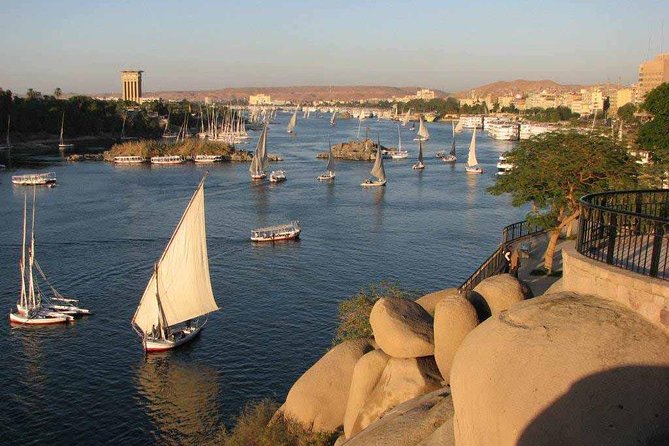
Aswan and Luxor are both essential stops in southern Egypt, but they offer different moods. Aswan is tied closely to the Nile, Nubian culture, and the great monuments around the first cataract. Luxor is ancient Thebes, the pharaonic capital whose temples and tombs fill both banks of the river.
The distance matters. The trip covers about 280 kilometers north of Aswan, and the drive takes several hours in each direction. That sounds daunting, but it gives you a way to see Luxor without changing hotels, arranging a separate transfer, or trying to piece together several taxis and admissions.
I like this setup best for someone with limited time in Egypt. You get the main West Bank and East Bank sights in one organized run. You also have a guide beside you, which matters at places where a wall full of gods, crowns, and hieroglyphs can otherwise become a blur.
The tradeoff is simple: convenience costs you energy. You will spend a large part of the day in the vehicle, then walk through exposed archaeological sites in the heat. If you have two or three nights in Luxor, staying there would be easier. If Aswan is your base and Luxor is a priority, this tour is a practical solution.
A few more Aswan outings to price up
- 4-Days Nile Cruise From Aswan To Luxor including Abu Simbel and Hot Air Balloon
★ 5.0 · 3,142 reviews - From Aswan: Abu Simbel Temple Day Trip with Hotel Pickup
★ 4.4 · 2,807 reviews - 4-Day 3-Night Nile Cruise from Aswan to Luxor&Abu Simbel+Balloon
★ 5.0 · 2,023 reviews
The Drive Through the Nile Valley
Pickup is offered from your Aswan hotel or Nile cruise, followed by transport in a private air-conditioned vehicle. The trip is designed for your own party rather than a large shared coach, so you avoid collecting people at several hotels and waiting for strangers.
The road also gives you a look at daily life beyond the monuments. The Nile Valley is a narrow strip of cultivated land, and the route offers views of traditional villages and fields. These passing scenes help explain why ancient Egypt grew where it did: water and fertile soil create a sharp contrast with the dry land beyond.
The schedule deserves careful attention. The published details list pickup at 7:00 PM, arrival in Luxor at 10:00 AM, and a total duration of about 13 hours. Those times do not fit neatly together, so confirm the departure hour with Emo Tours Egypt after booking. This is not a minor point. A day trip of this length depends on knowing when you leave and when you return.
The driver is an important part of the experience. Chico is praised for punctuality and care, while another report notes that a driver named Mohammed spoke enough English to communicate but was not fluent. That is not necessarily a problem because the Egyptologist guide handles the site explanations, but it is useful to know that driver and guide roles may be separate.
Valley of the Kings: Tombs Cut Into the Hills
Your first major stop is the Valley of the Kings on Luxor’s West Bank. This dry valley served as a burial ground for pharaohs, including rulers from the New Kingdom. Instead of building grand pyramids in the open, royal tomb builders cut chambers into the surrounding hills and decorated them with scenes meant to guide the dead into the next world.
The appeal is underground and visual. Inside the tombs, painted figures, royal names, gods, and ritual scenes cover the walls. The colors can still be striking after more than 3,000 years, though the experience varies from tomb to tomb.
The basic entry fee is included. The tour information notes that admission covers the basic area, so special tombs or optional entries may require an additional payment. King Tutankhamun’s tomb, for example, is often treated as a separate choice at Luxor, so ask your guide exactly what your ticket covers before entering.
You will hear names such as Thutmose I, Thutmose III, Tutankhamun, Ramesses VI, Merenptah, and Amenhotep II connected with the valley. A good guide helps you understand why the tombs were built here and how their decoration worked, rather than simply pointing out a painted figure.
Allow yourself to manage your energy. The valley is only one part of the day, and the heat can build quickly. Comfortable shoes, water, and a hat are sensible. Bottled water is included, but carrying your own refill or extra bottle is still useful on a long outing.
Hatshepsut’s Temple and the Story of a Female Pharaoh
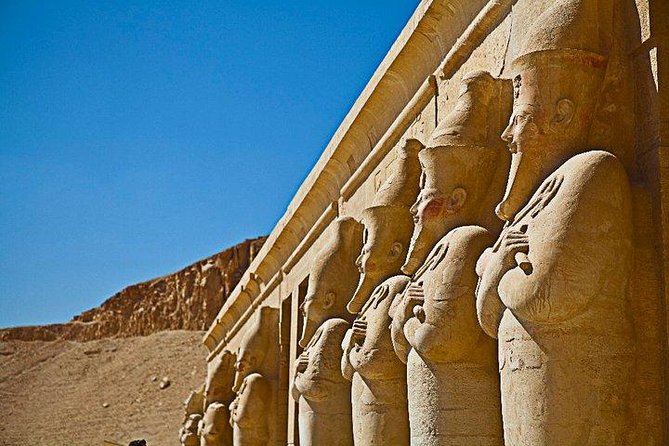
From the valley, the tour continues to the Temple of Hatshepsut at Deir el-Bahari. The temple is built against a steep rock face, with broad terraces rising toward the cliffs. Its setting gives it a different character from the tombs: open, geometric, and designed to impress from a distance.
Hatshepsut ruled Egypt for about 20 years during the 18th Dynasty. She was the daughter of Thutmose I and the only woman identified in this tour description as having ruled ancient Egypt as pharaoh. Her reign and public image give your guide plenty to explain, including how royal power was presented through statues, inscriptions, and temple design.
This is one of the places where a guide adds real value. The monument’s story is not obvious from its terraces alone. You will want help reading the reliefs and understanding the political role of the temple.
The two-hour West Bank block includes the Valley of the Kings, Hatshepsut’s temple, and the Colossi of Memnon. That gives you a useful amount of time, but it is not an invitation to wander without watching the clock. The day still has Karnak and Luxor Temple ahead.
Same base, a completely different sort of day:
- 4-Day 3-Night Nile Cruise from Aswan to Luxor including Abu Simbel, Air Balloon
★ 4.5 · 612 reviews - From Aswan: 3-Day Cruise to Luxor with Hot Air Balloon
★ 4.3 · 598 reviews - From Aswan: 4-Day Nile Cruise from Aswan to Luxor with Guide
★ 4.1 · 593 reviews - 4-Days Nile Cruise From Aswan To Luxor including Abu Simbel and Hot Air Balloon
★ 4.5 · 509 reviews
The Colossi of Memnon in Half an Hour
The Colossi of Memnon are two huge stone statues of Amenhotep III. They once guarded the front of his mortuary temple, which was the largest temple in the Theban Necropolis before much of it disappeared.
The stop is short, about 30 minutes, but the statues deserve it. Their size is easier to understand when you stand near their feet and look up at the seated figures. They have been in place since about 1350 BC and were known to Greek and Roman visitors.
The name Memnon comes from a later Greek misunderstanding. Ancient visitors connected the northern statue with Memnon, a figure from Greek mythology, and inscriptions in Greek and Latin were added during the Roman period. Your guide can turn what looks like a quick photo stop into a compact lesson about how later cultures interpreted older monuments.
Do not expect a full temple visit here. The surviving statues are the focus. This is a good place for photographs, especially if you want a sense of scale, but the tour moves on quickly.
Karnak: The Day’s Biggest Monumental Hit
After lunch, the route crosses to Luxor’s East Bank for Karnak Temple. The complex is enormous, with temples, pylons, chapels, columns, and later additions spread across a wide sacred area. Construction began in the Middle Kingdom under Senusret I and continued into the Ptolemaic period.
Karnak was the main religious center of ancient Thebes and was dedicated chiefly to Amun, head of the Theban Triad. Its scale can be difficult to take in during a one-hour visit. You may find yourself moving from gateway to courtyard to columned hall while trying to keep the larger plan in view.
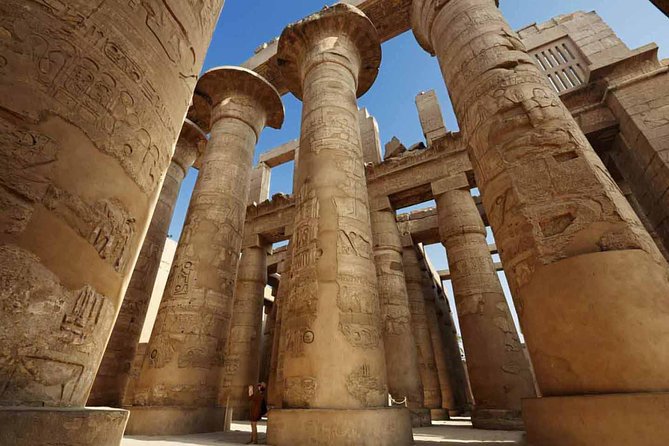
The Great Hypostyle Hall is the visual centerpiece for many people, with its forest of massive columns and carved surfaces. The scale tells you something that a textbook cannot: this was not a small shrine but a religious complex expanded by rulers over many centuries.
The one-hour allocation is useful but tight. Listen closely as the guide sets the route, and ask which features deserve your attention. Without direction, you can spend too long at the first courtyard and rush the later sections.
Karnak is also part of the ancient city of Thebes, a UNESCO World Heritage site. That recognition is not the reason to visit, but it underlines the site’s importance. You are seeing a long record of Egyptian building, royal ambition, religious practice, and later additions in one place.
Luxor Temple and the Idea of Kingship
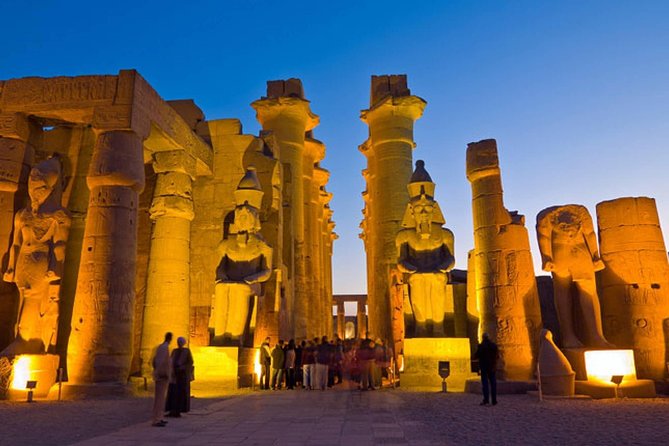
The final major stop is Luxor Temple, also on the East Bank. It was built around 1400 BCE and was known in ancient Egyptian times as Ipet Resyt, the southern sanctuary.
Its purpose differs from that of Karnak. Luxor Temple was linked to the renewal of kingship rather than being dedicated simply to a single cult god or a dead ruler. The site may have played a role in royal coronation ceremonies, at least in religious or symbolic form.
That distinction makes the temple especially rewarding at the end of the day. After seeing royal burials and monumental religious architecture, you finish with a place tied to the continuing power of the living king.
The temple is known for its large scale, reliefs, columns, and ceremonial spaces. The guide can help you follow the relationship between the temple and Karnak, which were connected in ancient times. You will get one hour here, enough for the main areas but not every detail.
By this point, fatigue is a real factor. Still, Luxor Temple often works well as a final stop because its layout is easier to follow than Karnak’s sprawling complex. Once the visit ends, the vehicle takes you back to your Aswan hotel or cruise.
What the Guide Adds to the Experience
The strongest reason to book this tour is the Egyptologist guide. These monuments are not self-explanatory. Their symbols, changing rulers, reused spaces, and later interpretations require context.
Mohamed Hashimi receives particular praise for taking care of practical details and helping a family with photographs. Ayman is described as giving detailed explanations at each temple. Ahmed is praised for good photos, while Ashraf is singled out for an excellent visit to the Valley of the Kings and Karnak. Ghada Khalaf is noted for her knowledge, humor, and determination during heat and Ramadan.
Those details suggest a useful pattern: the guides do more than recite dates. They help with photos, adjust communication, and keep the day pleasant. One account notes that a guide changed language and adapted to the group. That kind of flexibility matters during a private tour because your pace and questions can shape the day.
Guide quality can vary, of course. Ask questions early, especially about which tombs are included, how lunch will work, and how much time you have at each site. A clear conversation at the start helps you get more from the limited hours.
Lunch, Costs, and What $140 Covers
The price is $140 per person. For a private day trip covering the Aswan to Luxor transfer, a private air-conditioned vehicle, a professional Egyptologist guide, hotel pickup and drop-off, bottled water, and the listed entrance fees, that can be fair value.
The value is strongest for a small group. Since the activity is private, the cost buys control as well as transport. You are not simply paying for a seat in a bus. You are paying to have the day arranged around your group, with the main admissions handled in advance.
Lunch is optional and not included in the listed price. That is worth clarifying before departure. You may prefer the convenience of a local restaurant, or you may want to bring something simple so you can protect your sightseeing time.
Tipping is also not included, and optional tours cost extra. Keep those expenses in your budget rather than treating $140 as the final amount.
Group discounts may be available, which improves the value for families or friends. The tour is booked an average of 38 days ahead, so planning early is sensible if your Aswan dates are fixed.
Who Should Book This Day Trip?
I would choose this tour if you are staying in Aswan, want to see Luxor’s essential monuments, and have no wish to arrange a separate overnight stay. It is especially suitable for families and small private groups that value help with transport, explanations, and photographs.
It can also work for first-time visitors who want a guided introduction to ancient Thebes. The route gives you the major themes: royal burial, female kingship, mortuary worship, temple religion, and the renewal of the pharaoh’s power.
I would think twice if you dislike long drives or want slow, detailed visits. The 13-hour schedule is ambitious, and the two-bank program leaves little room for lingering. Anyone with mobility concerns should also consider the amount of walking at archaeological sites, though the supplied information says most people can participate.
The free cancellation policy allows cancellation up to 24 hours before the start time for a full refund. Changes made inside that 24-hour window are not accepted, so keep the cutoff in mind.
Is the Aswan to Luxor Tour Worth Booking?
Yes, if your time is limited and Luxor is high on your Egypt list. The tour gathers the essential sites into one private day, includes the major admissions and transport, and puts an Egyptologist guide between you and a great deal of confusing stone.
The price is reasonable for a private experience, especially when shared by a family or small group. The main warning is the schedule. Confirm the correct pickup time, ask what the basic entry ticket includes, and settle the lunch plan before you leave.
Book it if you want coverage, context, and convenience from Aswan. Skip it only if you can stay in Luxor longer and prefer a slower pace.
FAQ
How long is the tour from Aswan to Luxor?
The experience lasts approximately 13 hours. The route covers about 280 kilometers from Aswan to Luxor, with sightseeing on both the West Bank and East Bank.
Is hotel pickup included?
Yes. Pickup and drop-off are included from your hotel or Nile cruise in Aswan.
Is this a private tour?
Yes. Only your group participates in the activity, and transport is provided in a private air-conditioned vehicle.
Which sites are included?
The route includes the Valley of the Kings, Temple of Hatshepsut at Deir el-Bahari, Colossi of Memnon, Karnak Temple, and Luxor Temple.
Is an Egyptologist guide included?
Yes. A professional Egyptologist guide is included.
Is lunch included in the price?
No. Lunch at a local restaurant is optional and is not included in the listed price.
Are entrance fees included?
Entrance fees to the mentioned historical places are included, but the basic area admission applies. Optional tours or special entries may cost extra.
Can I cancel for a full refund?
Yes. You can cancel at least 24 hours before the experience start time for a full refund. Cancellations or changes made less than 24 hours before the start time are not accepted.
Newly listed around Aswan
- Sailing Nile Cruise from Aswan to Luxor for 2 Nights★ 4.5 · 139 reviews
- Philae Temple and Aswan High-Dam Half-day tour★ 5.0 · 49 reviews
- Private Tour in Aswan : Felucca and Nubian village★ 5.0 · 29 reviews
- Abu Simbel Private Full-Day Tour from Aswan★ 5.0 · 114 reviews
- (3-Nights Cruise From Aswan To Luxor & Balloon, Abu Simbel)★ 4.5 · 23 reviews
- Day Tour to Abu Simbel from Aswan by Bus★ 4.5 · 25 reviews
- 4-Days Aswan sails Nile Cruise Luxor &Abu Simbel.Hot air Balloon★ 4.5 · 77 reviews
- Nubian Village by Motorboat In Aswan★ 5.0 · 97 reviews
Aswan Tours, compared.

4-Days Nile Cruise From Aswan To Luxor including Abu Simbel and Hot Air Balloon
Read our review →

4-Day 3-Night Nile Cruise from Aswan to Luxor&Abu Simbel+Balloon
Read our review →
4-Day 3-Night Nile Cruise from Aswan to Luxor including Abu Simbel, Air Balloon
Read our review →
4-Day Nile Cruise from Aswan to Luxor with Guide
Read our review →4-Days Nile Cruise From Aswan To Luxor including Abu Simbel and Hot Air Balloon
Read our review →
Private Day Tour to Abu Simbel Temples from Aswan
Read our review →Browse the lists this tour appears in