
Reviewed · GIZA PYRAMIDS TOURS
Private Day Tour Saqqara Pyramids, Memphis and Dahshur Pyramids
Ancient Egypt gets better away from Giza. This private Cairo day tour takes you to Saqqara, Dahshur, and Memphis, where the monuments feel more connected to the story of pyramid building and often far less crowded. I like the private vehicle and guide, which let you set the pace, and I like the chance to enter the Red and Bent Pyramids without spending the day in the busiest tourist zone. The main consideration is physical: climbing inside the pyramids means tight passages, steep descents, and hot, enclosed spaces.
The tour runs about six to seven hours and includes pickup and return to Cairo or Giza hotels. Guides such as Ahmed, Wael, Hussam, Anan, Mahmoud, Ibrahim, Lobna, Ayman, and Ahmed Saber have been praised for clear explanations, patience, humor, and care. Bring WhatsApp for pre-tour contact, and ask about the optional lunch and any extra admission fees before setting out.
In This Review
- Key reasons this tour works well
- Why Saqqara deserves your first pyramid morning
- The Step Pyramid and the birth of monumental stone building
- Dahshur shows how pyramid builders learned
- Entering the Red Pyramid
- The Bent Pyramid is a remarkable work in progress
- Memphis brings the kings back into the picture
- What the private format changes
- Food, water, and the real cost
- Who should book this Cairo pyramid day?
- Should you book it?
- FAQ
- How long does the private tour last?
- Where does hotel pickup operate?
- Is this a private tour?
- Is lunch included?
- Are entrance fees included?
- Can I enter the Red and Bent Pyramids?
- Is bottled water provided?
- What is the cancellation policy?
Key reasons this tour works well
- Saqqara begins the pyramid story: See Djoser’s Step Pyramid, the first huge stone pyramid, and the wider funerary complex around it.
- Red and Bent Pyramids offer real exploration: You may enter both, but the passages require fitness and a calm head in confined spaces.
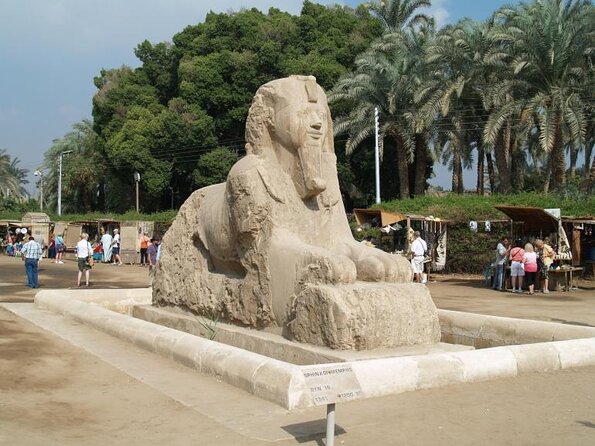
- Memphis adds the royal capital: The colossal Ramesses II statue and alabaster sphinx make the ancient capital more than a quick photo stop.
- A private schedule cuts down on rushing: You can spend more time at the places that interest you and adjust the order or pace with your guide.
- The route avoids a Giza-only Egypt trip: Saqqara and Dahshur show the experiments that led to the smooth-sided pyramids.
- The price is strong for a private outing: At $60 per person, the package offers transport, a guide, bottled water, and area entry fees when that option is selected.
Why Saqqara deserves your first pyramid morning
Saqqara is where the tour starts, and that is a smart choice. The site gives you the background needed to understand the later pyramids at Dahshur. Instead of seeing only the finished shape, you follow an ancient building experiment in progress.
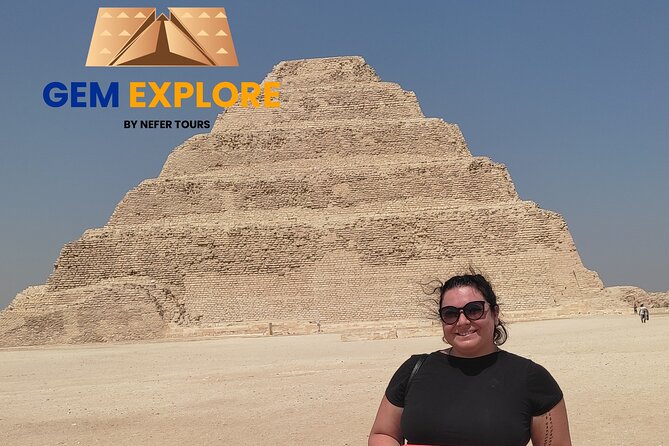
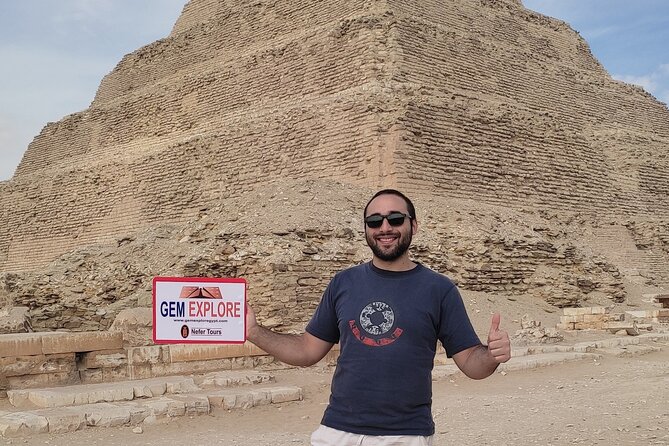
The star is the Step Pyramid of Djoser, dated to about 2670 BC. It is widely identified as the oldest colossal stone structure in the world. Before this design, royal tombs had a different form. Djoser’s monument stacks six stepped levels above a large enclosure, creating a bold bridge between earlier burial traditions and the classic pyramid shape.
Your guide should explain the role of Imhotep, the architect linked with the project, along with the complex’s colonnaded entrance, enclosure wall, Sed Festival area, north and south pavilions, southern tomb, and surrounding burials. That wider setting matters. The Step Pyramid is not an isolated triangle in the sand, but one part of a large ceremonial site built for the king’s afterlife.
You get roughly an hour at Saqqara as a general stop, followed by more focused time at Djoser’s pyramid and complex. The exact split can be flexible, which helps if you want photographs, more explanation, or a slower look at the architecture.
Admission to the main area is included when you choose the applicable entry option. Going inside the pyramid or entering the Southern Tomb requires a separate ticket. Your guide can help arrange that, but you should confirm the cost before paying.
Saqqara has another advantage: it gives you room to think. Giza can overwhelm you with size, crowds, vendors, and competing sights. At Saqqara, you can better see how royal architecture developed. I would not treat this as a quick box-ticking stop. If you care about ancient Egypt, give the site your attention.
More Saqqara, Memphis and Dahshur days:
- VIP All inclusive Best of the best Giza Pyramids,Sakkara,Memphis
★ 5.0 · 3,164 reviews - From Cairo: Pyramids of Giza, Sphinx, Saqqara & Memphis Tour
★ 4.7 · 3,110 reviews - Cairo: Pyramids, Sakkara & Memphis Tour with Lunch
★ 4.6 · 2,493 reviews
The Step Pyramid and the birth of monumental stone building
Djoser’s pyramid is especially useful for first-time Egypt visitors because it explains the leap from smaller royal tombs to monumental stone architecture. The guide’s commentary can turn a pile of ancient masonry into a sequence of decisions: how to shape the structure, how to organize the enclosure, and how to create a royal setting on a scale no earlier ruler had attempted.
The complex also helps you appreciate that pyramids were not just burial objects. The courtyards and festival areas were tied to kingship and ritual. Ask your guide about the Sed Festival complex and the purpose of the surrounding walls. A private tour gives you a better chance to ask those extra questions instead of waiting for a group to move on.
The tour description allows flexible timing, but six to seven hours is not an unlimited amount of time. If you want to enter extra tombs, spend a long time photographing details, or examine every part of the enclosure, tell your guide early. Otherwise, the schedule may favor a broad look at all three ancient areas.
Dahshur shows how pyramid builders learned
After Saqqara, the route continues to Dahshur, generally with lunch before the next section if you select that arrangement. Dahshur is one of the most rewarding parts of the day because the pyramids here show a clear stage in the move from stepped sides to the smooth faces associated with Egypt’s later pyramids.
The Red Pyramid and Bent Pyramid are the main attractions. Both were built during the reign of Sneferu, between about 2613 and 2589 BC. They are among Egypt’s oldest and best-preserved large pyramids, and they reveal the practical problems ancient builders had to solve.
You begin with a short Dahshur area visit, then spend about 45 minutes at each pyramid, though the schedule can change. This is where the private format earns its keep. You can take time to recover after one climb, ask for a slower pace, or move on if the enclosed passages are not for you.
The open desert setting also changes the mood. You are looking at major royal monuments without the same urban pressure that surrounds Giza. The quiet is not guaranteed, but the site is generally a calmer part of a Cairo pyramid day.
Entering the Red Pyramid
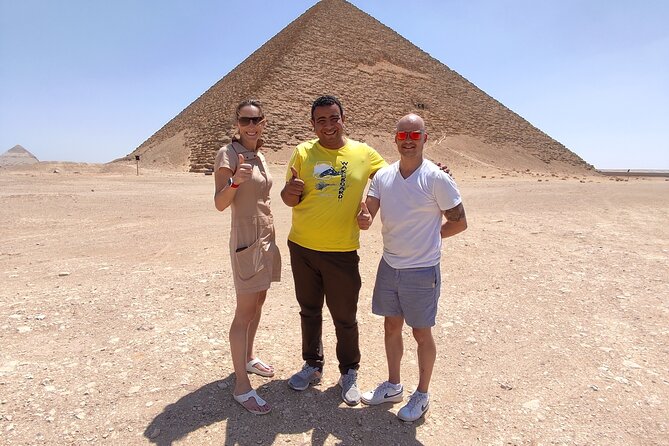
The Red Pyramid is often the physical highlight of the tour. It is also called the North Pyramid and is regarded as the first classic smooth-sided pyramid in ancient Egyptian history. Its reddish limestone gives it its modern name, with the stone associated with the Tura Mountains near Cairo.
Entry may be free under the current arrangements, but confirm this with your guide because site rules and ticket conditions can change. The interior is not a simple walk through a doorway. You should expect a demanding route, and the description specifically warns that the Bent Pyramid can be difficult for anyone with claustrophobia or health concerns.
Inside, you may need to climb or descend through narrow, steep corridors. The air can feel close, and the physical effort is real. Wear shoes with a secure grip, carry water, and do not enter just because other people are doing it. If you are fit and comfortable in confined spaces, the experience gives you a direct sense of pyramid construction that an exterior view cannot provide.
Several people have singled out entering the Red Pyramid as the best part of their day. That makes sense: it combines ancient engineering with a little personal challenge. Still, the guide cannot remove the steep passages, so treat this as an optional adventure, not a required part of the tour.
More ways to see the Pyramids and the Sphinx:
- Cairo: Pyramids & Great Sphinx Private Tour with Camel Ride
★ 4.9 · 6,335 reviews - Tour to Giza Pyramids and The Egyptian Museum
★ 5.0 · 6,016 reviews - Cairo 8 Hour Private Tour of Pyramids, Egyptian Museum and Bazaar
★ 5.0 · 2,931 reviews - From Cairo: Half-Day Tour to Pyramids of Giza and the Sphinx
★ 4.6 · 2,891 reviews
The Bent Pyramid is a remarkable work in progress
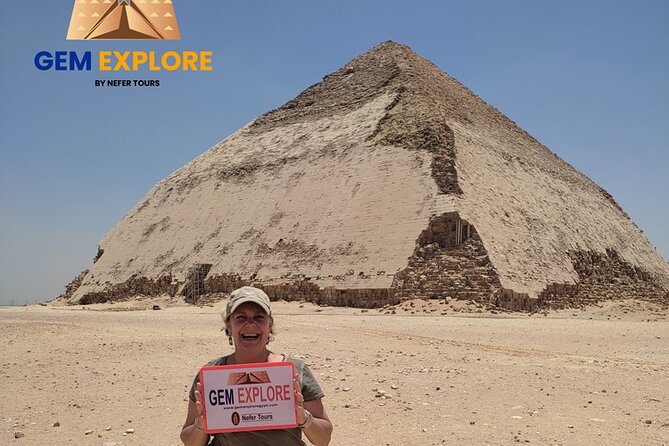
The Bent Pyramid is one of Egypt’s most distinctive monuments. Its lower section rises at a steep angle, then changes direction partway up, creating the bent profile that gives it its name. The design captures a moment when builders were still testing how to raise a stable smooth-sided pyramid.
It is also noted for retaining much of its outer casing, which gives the structure a more finished appearance than many pyramids whose outer stone was removed over time. The pyramid was Sneferu’s second major pyramid, and its unusual shape makes the construction story visible from a distance.
You may enter the Bent Pyramid as well. This is the more demanding choice, with a narrow route that calls for fitness and comfort in enclosed spaces. If you have respiratory, mobility, heart, or other health concerns, skip the interior. You will still get plenty from viewing the exterior and hearing how the change in angle relates to pyramid building.
A private guide is useful here because you can make the decision without feeling pushed by a group schedule. Ask how much time remains and choose the entrance that suits your energy. The best pyramid experience is one you can enjoy safely.
Memphis brings the kings back into the picture
The final major area is Memphis, the ancient capital associated with the Old Kingdom, dated here to about 2686 BC. This stop shifts the focus from royal tombs to the city and political power that supported them.
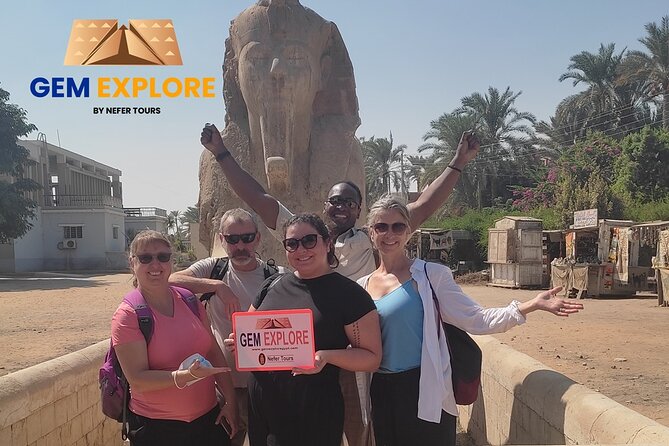
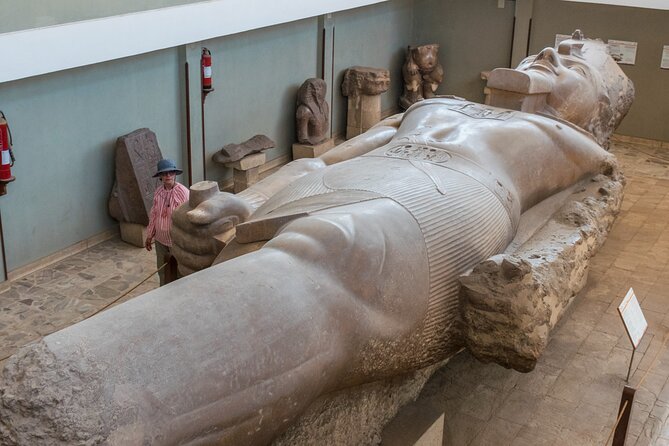
The remains are more scattered than the huge pyramid forms at Saqqara and Dahshur, so your guide’s explanation matters. Memphis was a center of power and the home of rulers connected with the pyramid age. You will see the colossal limestone statue of Ramesses II and the large alabaster sphinx at the Mit Rahina Museum.
Ramesses II ruled for about 67 years, from 1279 BC according to the supplied information. The enormous statue is impressive even when viewed lying down, and its condition lets you study the formal style of royal sculpture. Your guide can help you notice details that are easy to miss if you simply walk around taking photographs.
The Memphis sphinx is made from alabaster and is linked here with the famous queen Hatshepsut, dated to 1479 BC. It is not the Great Sphinx at Giza. That distinction is worth keeping clear. This is a smaller but historically important statue near the remains of Memphis, and its pale stone gives it a different character.
You spend about 30 minutes at Memphis and another 30 minutes at the Mit Rahina Museum and sphinx area. That is enough for the principal monuments, though not for an exhaustive study of every ruin. If Memphis is a priority for you, say so at the start and ask how the time will be divided.
What the private format changes
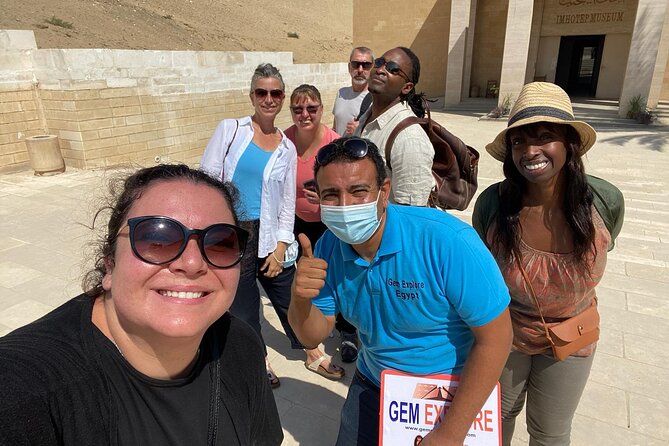
The private setup is not just a nicer vehicle. It changes how you use the day. You are collected from your Cairo or Giza accommodation, travel with your own guide and driver, and return to the same general area at the end. There is no shared group waiting for late arrivals or a fixed pace that ignores your interests.
Past guide assignments have included Ahmed, Wael, Hussam, Anan, Mahmoud, Ibrahim, Lobna, Ayman, and Ahmed Saber. The most consistent praise has focused on clear teaching, patience, humor, good English in specific cases, help with photographs, and attention to comfort and safety. One guide adjusted the day after an airport detour, while another was praised for helping visitors avoid unwanted pressure from local sellers.
Drivers are also an important part of a Cairo day. Traffic can be intense, and visitors specifically appreciated polite drivers, comfortable transport, and safe handling of the road. You will spend time in the vehicle between the three archaeological areas, so this support affects the whole experience.
Flexible start times help if you are working around flights, hotel schedules, or another Cairo visit. Contact before the day is useful, and WhatsApp may be used one or two days in advance. Download it before your trip if you do not already use it.
Food, water, and the real cost
The listed price is $60 per person. For a private six to seven hour tour with hotel pickup, return transport, a guide, bottled water, and area entry fees when the correct option is selected, that is a solid value, especially for two or more people sharing a private vehicle. Group discounts may improve the price for larger parties.
Lunch is optional and costs extra if selected. The day’s plan refers to lunch before continuing at Dahshur, and one particularly positive account described a rooftop restaurant with good views. Since the meal is not included in the base price, ask what is offered and what it costs before you sit down.
Airport, New Cairo, Nasr City, and 6th of October pickups carry an extra $15 per person. Pickup from the New Administrative Capital carries an extra $20 per person. These fees can change the value calculation for solo visitors, so check your pickup zone carefully.
Bottled water is included, but you should still dress for heat and walking. The pyramid interiors call for more care than the museum stops. Light clothing, secure shoes, and a willingness to skip an interior if you feel unwell will make the day better.
Free cancellation is available up to 24 hours before the start time for a full refund. Changes or cancellations inside that window are not accepted or refunded.
Who should book this Cairo pyramid day?
I would choose this tour if you want more than a photograph at the Great Pyramids. It suits first-time Egypt visitors who want a clear explanation of how pyramid design changed, as well as repeat visitors who have already seen Giza and want a quieter archaeological day.
It is particularly good for couples, families, and small groups who value control over the schedule. The private format also helps if one person wants to enter a pyramid while another prefers to stay outside.
I would hesitate if you want a slow archaeological study of every tomb and ruin. The route covers a lot in six to seven hours, and the short Memphis stops may feel brief to a specialist. I would also hesitate if narrow, steep pyramid passages are impossible for you, though you can simply enjoy the exteriors.
Should you book it?
Book this tour if you want Saqqara’s architectural story, Dahshur’s pyramid experiments, and Memphis’s royal statues in one manageable day. The strongest reasons are the private pace, hotel transport, access to the Red and Bent Pyramids, and guides who have earned praise for teaching rather than merely pointing.
Before booking, confirm your pickup area, lunch choice, entry options, and which pyramid interiors are open. Ask for a guide such as Ahmed, Wael, Hussam, Anan, Mahmoud, Ibrahim, Lobna, Ayman, or Ahmed Saber if availability allows, but remember that assignments are not guaranteed.
At $60 per person, this is a practical way to get beyond Giza. If you can handle the heat and the pyramid passages, it may become the most revealing ancient Egypt day of your Cairo stay.
FAQ
How long does the private tour last?
The experience lasts approximately six to seven hours, including visits to Saqqara, Dahshur, and Memphis, plus pickup and return transportation.
Where does hotel pickup operate?
Pickup and drop-off are offered from accommodations in Cairo or Giza. Pickup from the airport, New Cairo, Nasr City, and 6th of October costs an extra $15 per person. Pickup from the New Administrative Capital costs an extra $20 per person.
Is this a private tour?
Yes. Only your group participates in the private activity.
Is lunch included?
Lunch is optional and costs extra. The tour information places lunch before the Dahshur visit.
Are entrance fees included?
Area entry fees are included if you select the option that includes them. Entering the Step Pyramid or Southern Tomb requires a separate ticket.
Can I enter the Red and Bent Pyramids?
You may have the chance to enter both. The interior routes can be narrow and physically challenging, particularly for anyone with claustrophobia or health concerns.
Is bottled water provided?
Yes. Bottled water is included.
What is the cancellation policy?
You can cancel up to 24 hours before the experience start time for a full refund. Cancellations or changes made less than 24 hours before the start time are not accepted or refunded.
Newly listed around Cairo
- Full Day Trip from Cairo to Luxor★ 5.0 · 16 reviews
- Private guide’s trip to Giza pyramids, Great sphinx valley temple★ 5.0 · 37 reviews
- Private half Day Tour to the Great 3 Pyramids of Egypt★ 5.0 · 15 reviews
- VIP Tour inside Giza Pyramids★ 4.5 · 103 reviews
- Full-Day Private Tour to Giza Pyramids, Sphinx, Memphis & Saqqara★ 5.0 · 106 reviews
- Unique Tour to The Grand Egyptian Museum and 12 main galleries★ 4.0 · 38 reviews
- Elite Boats Tour in Cairo & Giza with Drinks Included★ 4.5 · 15 reviews
- Sunset & Night Open Air Nile Cruise in Cairo & Giza★ 5.0 · 158 reviews
Giza Pyramids Tours, compared.
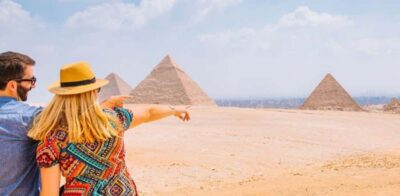
Pyramids & Great Sphinx Private Tour with Camel Ride
Read our review →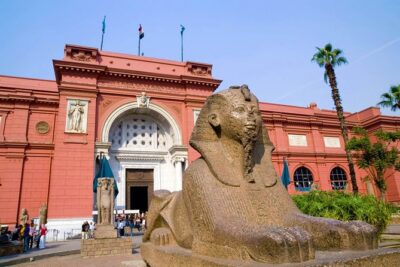
Tour to Giza Pyramids and The Egyptian Museum
Read our review →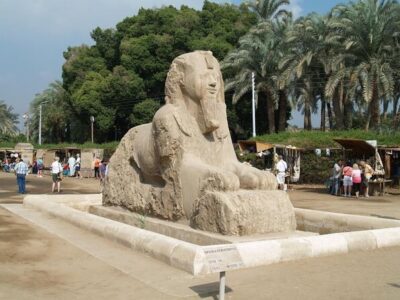
VIP All inclusive Best of the best Giza Pyramids,Sakkara,Memphis
Read our review →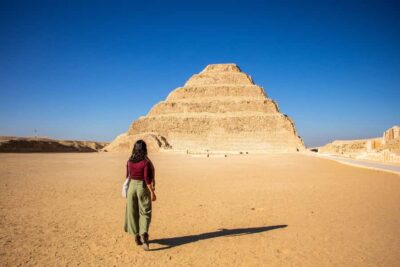
Pyramids of Giza, Sphinx, Saqqara & Memphis Tour
Read our review →
Cairo 8 Hour Private Tour of Pyramids, Egyptian Museum and Bazaar
Read our review →
Half-Day Tour to Pyramids of Giza and the Sphinx
Read our review →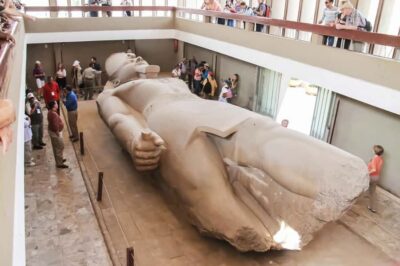
Private ViP all-inclusive Giza Pyramids,Sphinx,Inside Pyramid
Read our review →Browse the lists this tour appears in