
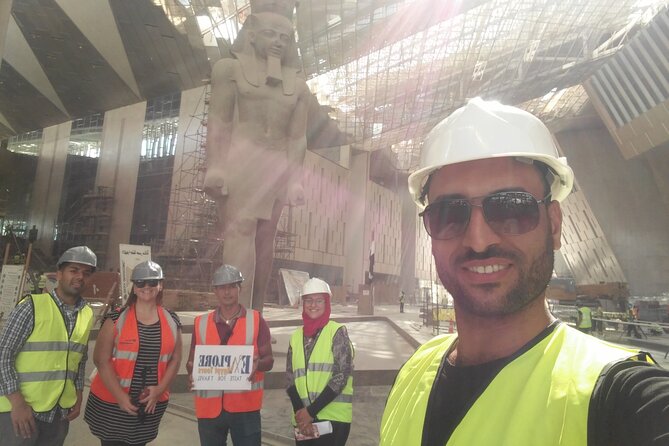
Reviewed · EGYPTIAN MUSEUM TOURS
Unique Tour to The Grand Egyptian Museum and 12 main galleries
The museum is still unfolding. I like the private hotel pickup and the chance to see major pieces with an Egyptologist instead of wandering without context. I also like the focused route through the Hanging Obelisk, Ramses II, the Grand Staircase, and the 12 main galleries. The catch is important: access has been limited during the museum’s trial opening, so the advertised visit may not include every gallery or exhibit.
At $79 per person, this can be a fair deal if your option includes admission, transport, and a guide. It becomes much less attractive if you arrive to see only the atrium and a few statues. Ask exactly what is open on your date, and check that entrance tickets are included in the price you select.
In This Review
- Key points before you book
- A practical way to reach the museum from Cairo or Giza
- The Garden and the first look at Egyptian scale
- The Hanging Obelisk and its unusual story
- Ramses II and the power of royal images
- Senusret I and the Middle Kingdom collection
- Ptolemaic rulers and the Mediterranean connection
- Victory Columns and the language of military power
- The Grand Atrium, shops, and modern architecture
- The Grand Staircase and its views
- What the 12 main galleries are meant to show
- What $79 buys you, and when it feels fair
- The guide makes the difference
- Who should book this museum visit?
- Should you book the Grand Egyptian Museum tour?
- FAQ
- Where does the tour provide pickup?
- How long does the experience last?
- Is the tour private?
- Is a guide included?
- Are museum entrance tickets included?
- Is lunch included?
- Can I cancel or change the booking?
Key points before you book
- Limited museum access matters most: The Grand Egyptian Museum has opened in stages, and some past departures allowed access only to public areas, the atrium, shops, restaurants, and selected displays.
- Private transport saves time: Pickup and drop-off from a Cairo or Giza hotel are included in a private, air-conditioned car.
- The guide adds the real value: Your Egyptologist explains the statues, royal symbols, religious ideas, and changing periods of Egyptian history.
- The grandest sights come early: The Hanging Obelisk, Ramses II, the Grand Atrium, and the Grand Staircase make a strong first impression.
- The 12 galleries may not all be open: The route describes more than 15,000 objects, but actual access depends on museum operating rules.
- Lunch is an upgrade: A traditional meal at a local restaurant is available with the appropriate booking option.
A practical way to reach the museum from Cairo or Giza
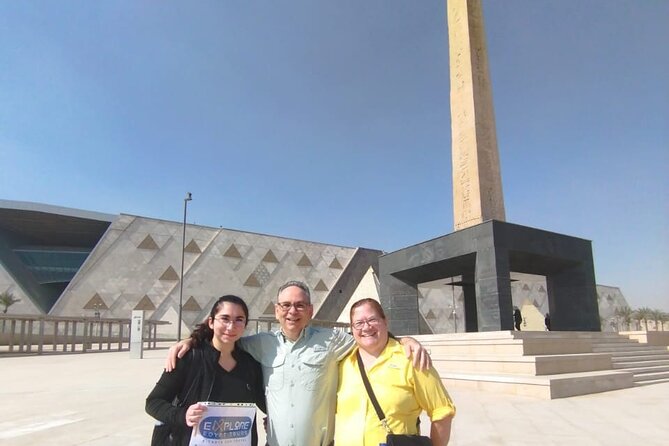
This tour begins with hotel pickup in Cairo or Giza. Your guide meets you at the hotel, then accompanies you in a private, air-conditioned car. That is a useful service in Egypt, where arranging a taxi, finding the correct entrance, and negotiating a return ride can eat up valuable time.
I especially like the door-to-door setup for a first visit to Cairo. You do not need to rent a car, and you do not have to figure out how to get back after three hours inside a very large museum complex. A bottle of water is included, and the price covers taxes and charges.
The tour lasts about three hours. That is enough time for a guided overview, but it is not a full-day museum study. If you enjoy reading every label or lingering over small objects, you may wish for more time. The guide’s job here is to give you the main story and keep the visit moving.
The experience is private in terms of your car and tour group. At the museum itself, the visit can involve other people because the building has operated with limited access during its trial phase. That distinction is worth understanding before you pay.
More museum visits in Cairo:
- From Hurghada: Pyramids and Egyptian Museum Tour & Boat Ride
★ 4.4 · 381 reviews - Egyptian Museum in Cairo: Private Guided Tour
★ 5.0 · 316 reviews - Cairo: Grand Egyptian Museum QR Ticket
★ 4.7 · 243 reviews
The Garden and the first look at Egyptian scale
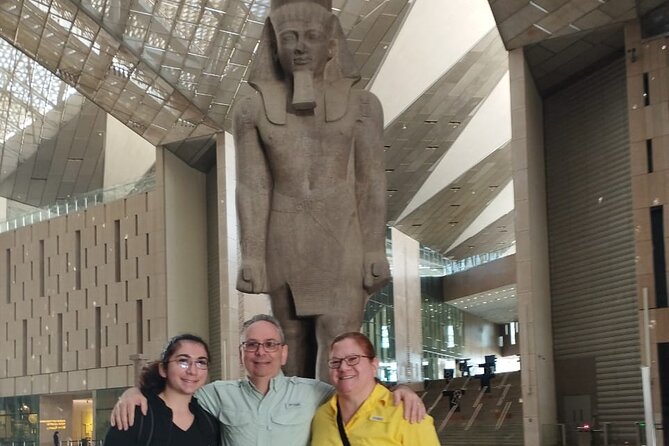
Your first stop is the Grand Egyptian Museum Garden. The garden gives you an initial sense of the museum’s size and modern design before you move into the main visitor areas.
The building is designed to honor ancient Egypt through a very modern structure. The scale is part of the appeal. Even before you reach the objects, the setting tells you that this is not a small collection squeezed into old rooms.
The first hour includes the Hanging Obelisk and the giant Ramses II statue. These are ideal opening sights because they show two different sides of ancient Egyptian achievement: engineering and royal power.
The Hanging Obelisk and its unusual story
The Hanging Obelisk is one of the more unusual objects on the route. It fell on its side after an earthquake but remained suspended, giving it the name used today. The story is easy to remember, and it gives your guide a natural way to explain how obelisks were made, moved, and used.
Its original history is also wide-ranging. It was intended for the Karnak Temple Complex, then moved to Alexandria and placed in the city’s central square. That movement helps you see ancient monuments as objects with long lives, not frozen pieces that always remained in one location.
I like this stop because it is more than a photo opportunity. A good guide can connect the obelisk to temple design, royal messaging, and the practical problems of moving huge stone monuments.
Ramses II and the power of royal images
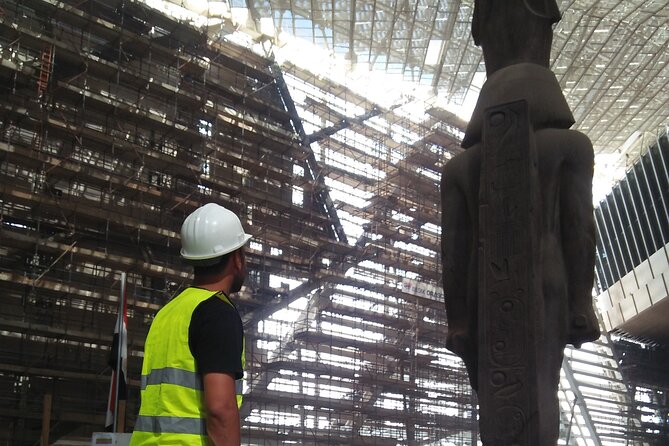
The giant statue of Ramses II gives you the classic Egyptian museum moment: a ruler shown at a size that makes ordinary people look tiny. The statue is part of the museum’s central display and helps explain how pharaohs used art to present themselves as powerful, permanent, and closely linked to the gods.
This is also a place where a private guide earns the fee. Without explanation, you see a huge statue. With explanation, you can look for the pose, clothing, symbols, and scale that communicate royal authority.
The first stop is listed as lasting about one hour, including admission when that option is selected. That is a sensible amount of time for the outdoor and major-statue displays, but the pace may feel brisk if you want detailed photography.
A few more Giza outings to price up
- Cairo: Grand Egyptian Museum Ticket w/ Opt. Guide & Transfer
★ 3.9 · 217 reviews - Giza Pyramids, the Grand Egyptian museum ” GEM “
★ 5.0 · 164 reviews - Grand Egyptian Museum
★ 5.0 · 153 reviews - Day-Tour To Giza Pyramids, Great Sphinx, Egyptian Museum & Khan El Khalili
★ 5.0 · 112 reviews
Senusret I and the Middle Kingdom collection
The next section focuses on the ten statues of Senusret I. Each statue shows the pharaoh in a different pose or outfit, offering a useful introduction to how Egyptian rulers were presented in formal art.
Senusret I ruled during the Middle Kingdom, a period known for renewed central power and careful royal imagery. The repeated statues let you compare small changes in posture and costume. The point is not simply that there are ten large figures. The arrangement lets you see how a ruler’s identity could be repeated, adjusted, and reinforced through sculpture.
Your guide can also help explain the difference between a portrait in the modern sense and an Egyptian royal image. These statues were made to express an ideal role, not just to record an individual face.
This portion lasts about 35 minutes. That is enough for a clear explanation, though not enough for a slow art-history lecture. If you already know Egyptian periods, you may want extra time to study the details yourself.
Ptolemaic rulers and the Mediterranean connection
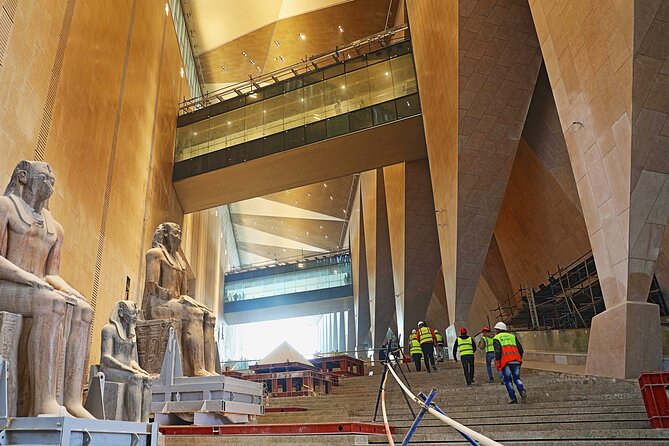
The route then brings you to colossal statues of a Ptolemaic king and queen. These figures were recovered from the Mediterranean Sea and carved from pink granite.
They offer a different view of Egypt from the age of the pharaohs. The Ptolemaic rulers came from the Hellenistic world, so these statues help show how Egyptian traditions continued under foreign dynasties. The combination of Egyptian royal form and later political history is one of the more useful themes in the museum.
The two figures also remind you that Egypt’s past was connected to the wider Mediterranean. This is not only a story of pyramids and temples. It includes trade, conquest, new ruling families, and changing artistic styles.
Victory Columns and the language of military power
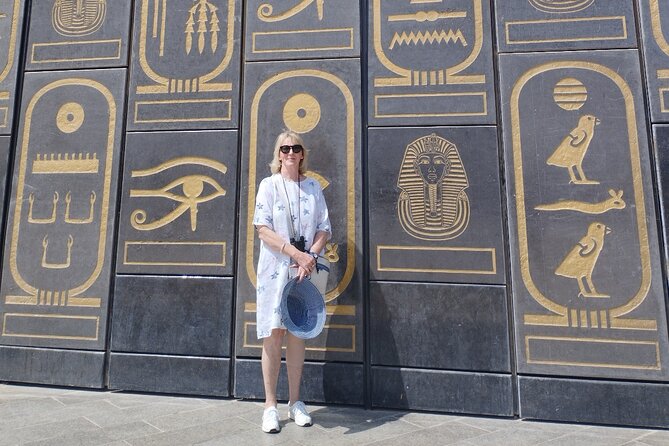
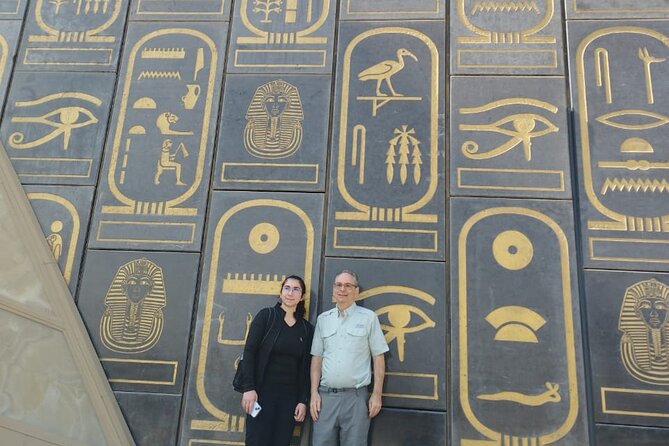
The Victory Columns commemorate military successes and carry carved decoration. Their scale makes them easy to appreciate from a distance, while the inscriptions and imagery reward a closer look.
I would listen carefully here for the guide’s explanation of how military victory was presented as proof of a ruler’s right to govern. Ancient Egyptian monuments often combine religion, politics, and public messaging. These columns show that connection clearly.
The stop is short, so it works best as part of the larger sequence rather than as a separate attraction. You get the main idea, a few photographs, and a link to the royal displays around it.
The Grand Atrium, shops, and modern architecture
The Grand Atrium is one of the museum’s most impressive spaces. It is a large, multi-story hall with major statues and a clean modern design. The high ceiling and open layout give the ancient objects room to breathe.
This is also where access problems have been most noticeable. At certain points during the trial opening, people could enter the main corridor and see the atrium displays, shops, and restaurants, but could not enter the main exhibition areas. If the museum has restricted access on your date, the atrium may become the main event rather than a short stop on the way to the galleries.
The gift shop is included in the route. You can browse before leaving, but personal spending is not included. The shop gives you a chance to buy something connected to the museum without having to make a separate stop elsewhere in Cairo.
The Grand Staircase and its views
The Grand Staircase is one of the best-known architectural features in the museum. Its walls include murals and hieroglyphic scenes connected to daily life, mythology, and Egyptian history.
I like this part because it links the building itself to the collection. You are not simply walking between rooms. The staircase is designed as part of the museum’s story, with the movement upward providing a sense of progression through time.
From the top, you may have views across the museum’s galleries and toward the Cairo skyline. The exact view can depend on which areas are open, but the staircase remains a strong place to pause and take in the scale of the building.
This section is listed at about 35 minutes. Bring comfortable shoes and allow time for photos, but remember that the staircase is a passage as well as a display area.
What the 12 main galleries are meant to show
The central promise of this experience is a journey through 12 main galleries and more than 15,000 objects. The displays cover ancient Egypt from prehistoric times through the Graeco-Roman period.
The galleries are arranged around major historical phases:
- The early periods through the Second Intermediate Period focus on divine kingship, pyramid building, and beliefs about the afterlife.
- The Middle Kingdom section shows the return of central authority and broader funerary practices.
- The New Kingdom presents Egypt’s golden age, with powerful rulers, temples, and royal treasures.
- The Graeco-Roman period shows how Egyptian traditions continued and changed under later rule.
That structure is helpful because Egyptian history can otherwise blur into one long list of pharaohs. A guide can give you a framework, explain why the periods differ, and point out objects that tell a larger story.
The advertised highlights include rare pieces and the treasures connected with King Tutankhamun. However, access to the full collection has not always been available. Some departures took place before the main exhibitions opened, and some people saw only a small number of public displays. You should treat the gallery access as the key condition of the booking, not as a minor footnote.
The tour also refers to a King Tutankhamun 3D video experience. When available, this can add a modern presentation to the ancient collection. It is different from viewing the actual objects, but it may be a memorable part of a limited-access visit.
What $79 buys you, and when it feels fair
The listed price is $79 per person. The value depends on what is included in your selected option and what the museum allows you to see.
At its best, the fee covers private transport from your hotel, a professional Egyptologist, museum admission, a bottle of water, and a carefully planned route. You are paying for convenience as much as for the three hours inside the building. For a first visit, the transport and explanations can make the day calmer and more useful.
The booking can also be upgraded to include a traditional lunch at a local restaurant. That is practical if you want the day arranged from start to finish, though it raises the total cost.
At its weakest value, you pay for a tour advertised around galleries and find that only the atrium, corridor, and a few statues are open. That has happened during the museum’s staged opening. Before booking, confirm three points:
- Are the entrance tickets included in the exact option you are selecting?
- Which galleries and exhibits are open on your date?
- Is the tour still running at the advertised time?
There has been confusion in the past over ticket inclusion, with one booking confirmation appearing to include admission even though the ticket arrangement was unclear. Get this detail in writing. The experience is non-refundable, so a misunderstanding is costly.
The guide makes the difference
The strongest part of the tour is the guide-led interpretation. A professional Egyptologist can explain what you are looking at, why it mattered, and how it fits into Egypt’s long timeline.
The quality of the individual guide still matters. Mahmoud received especially warm praise for his calm manner and clear explanations. Another guide named Azmy handled a start-time problem promptly and escorted a group to the museum’s conservation labs. Those details suggest that the operator can respond well when the arrangements are clear, but you should still confirm your pickup time before the day begins.
A guide is most useful at the statues of Ramses II and Senusret I, the Ptolemaic figures, and the Victory Columns. These objects can look impressive but confusing without context. A good explanation turns a quick stop into a lesson.
Who should book this museum visit?
I would choose this tour if you are staying in Cairo or Giza, want hotel transport, and prefer a guided first look instead of handling the museum alone. It suits history fans, families who want explanations in plain language, and anyone with only a few hours available.
It is less suitable if you are mainly booking for King Tutankhamun’s treasures or the full set of galleries. The museum’s access rules have changed during the trial opening, and several departures offered only limited interior access.
The experience also works best for people who value convenience. If you already have reliable transport and can arrange a museum ticket yourself, the $79 price may not offer enough savings. In that case, the guide is the main reason to book.
Should you book the Grand Egyptian Museum tour?
Book it if you confirm that your date includes the galleries you want, admission is part of your chosen price, and you value private pickup with a guide. The Hanging Obelisk, Ramses II, Senusret I, the Grand Atrium, and the Grand Staircase provide plenty to see even during a restricted opening.
Skip it, or wait, if your main goal is a full museum visit with every major collection on display. The safest choice is to ask about current access before payment, especially because the booking cannot be refunded or changed. At $79, this is a convenient guided introduction, not a guaranteed complete examination of the entire museum.
FAQ
Where does the tour provide pickup?
Pickup and drop-off are offered from hotels in Cairo or Giza.
How long does the experience last?
The tour lasts approximately three hours.
Is the tour private?
The transport and activity are private for your group, although the museum visit may involve other people during the trial opening and limited-access period.
Is a guide included?
Yes. A professional Egyptologist guide accompanies you through the museum visit.
Are museum entrance tickets included?
Entrance fees are included only if you select the option that includes tickets. Check the exact booking option before paying.
Is lunch included?
A traditional lunch at a local restaurant is available if you choose the lunch option. Personal spending and tipping are not included.
Can I cancel or change the booking?
No. The experience is non-refundable and cannot be changed for any reason.
Newly listed around Giza
- Full Day Trip from Cairo to Luxor★ 5.0 · 16 reviews
- Private half Day Tour to the Great 3 Pyramids of Egypt★ 5.0 · 15 reviews
- VIP Tour inside Giza Pyramids★ 4.5 · 103 reviews
- Private guide’s trip to Giza pyramids, Great sphinx valley temple★ 5.0 · 37 reviews
- Full-Day Private Tour to Giza Pyramids, Sphinx, Memphis & Saqqara★ 5.0 · 106 reviews
- Elite Boats Tour in Cairo & Giza with Drinks Included★ 4.5 · 15 reviews
- Sunset & Night Open Air Nile Cruise in Cairo & Giza★ 5.0 · 158 reviews
- Private Day Tour to Giza Pyramids & Sphinx , with Pickup★ 5.0 · 60 reviews
Egyptian Museum Tours, compared.

Tour to Giza Pyramids and The Egyptian Museum
Read our review →
Cairo 8 Hour Private Tour of Pyramids, Egyptian Museum and Bazaar
Read our review →Grand Egyptian Museum, Pyramids, Sphinx Tour & Lunch
Read our review →
Cairo Pyramids, Sphinx & Egyptian Museum Day Trip
Read our review →
Private tour to Giza Pyramids,Sphinx,Egyptian Museum with Local Lunch
Read our review →
Best Private Giza Pyramids,Sphinx, New Grand Egyptian Museum
Read our review →
Egyptian Museum, Citadel, and Old Cairo Guided Tour
Read our review →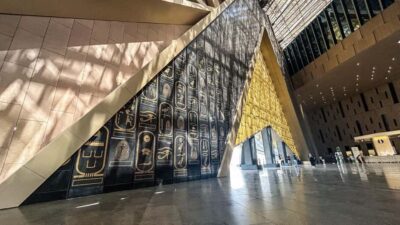
Grand Egyptian Museum, Pyramids & Sphinx Day Tour
Read our review →Browse the lists this tour appears in