
Reviewed · GIZA PYRAMIDS TOURS
Giza Pyramids Sakkara and Dahshur
Pyramids make more sense in sequence. This tour links Giza, Saqqara, and Dahshur so you can follow ancient Egyptian builders from early experiments to the famous royal tombs. I like the clear historical progression, and I also like the small-group limit of 15 people, which gives you a better chance to ask questions.
Hotel pickup, bottled water, an air-conditioned coach, a professional Egyptologist guide, and lunch are included. The main catch is that entrance tickets are extra, and the advertised five-hour duration may feel optimistic. Several accounts describe the outing as a full-day activity, especially when traffic, site visits, and lunch are included.
In This Review
- Key points to know before booking
- Why this route is better than seeing Giza alone
- Dahshur: where pyramid design took a wrong turn
- Saqqara and Djoser’s Step Pyramid
- Giza: the grand finale
- Guides who make the stones readable
- Transport, lunch, and the small-group format
- Is $46 a good value?
- Who should book this pyramid tour?
- Final decision: book it for the full pyramid story
- FAQ
- Where does the tour take place?
- Does the tour include hotel pickup?
- How much does the tour cost?
- Are entrance fees included?
- How long does the tour last?
- What is included in the price?
- How many people can join the group?
- Which pyramids can you see at Giza?
- Can you enter the pyramids?
- What is the cancellation policy?
Key points to know before booking
- The route explains pyramid development: Dahshur, Saqqara, and Giza are not random stops. Together, they show how pyramid design changed over time.
- Giza is only part of the story: You see the pyramids of Khufu, Khafre, and Menkaure, plus the Sphinx, but the older sites provide the best context.
- Dahshur feels less crowded: The Bent Pyramid and Red Pyramid offer a quieter look at royal pyramid building away from Giza’s busiest setting.
- Saqqara adds more than one pyramid: Djoser’s Step Pyramid is the centerpiece, with tombs and wall carvings adding depth to the visit.
- Guides receive the strongest praise: Zizou, Hosni, Mahmoud, Emad G, Ahmed, and others are described as patient, clear, and enthusiastic. Your assigned guide will vary.
- Budget for entrance fees and tips: The $46 price covers transport and services, but not admission tickets, gratuities, or optional extras.
Why this route is better than seeing Giza alone
Giza is the famous chapter, but it is not the whole book. If you visit only the Great Pyramid and Sphinx, you see the finished product without following the engineering steps that came before it.
This route begins at Dahshur, continues to Saqqara, and includes Giza. The order lets you compare different designs and building periods. You can see an early pyramid with a dramatic change in angle, a step pyramid built from stacked levels, and the smooth-sided giants that became Egypt’s best-known symbols.
I like this approach because it turns a day of monument viewing into a simple story. You are not just collecting photographs. You are watching royal tomb design change from one generation to the next.
The tour is also a sensible choice if you have limited time in Cairo. Hotel pickup and drop-off remove the need to arrange separate transport to three sites spread around the city. You get a guide, driver, lunch, and bottled water in one package.
The tradeoff is pace. Three major archaeological areas require time in the vehicle and time on foot. The official description gives about two hours at Giza and three hours at Dahshur and Saqqara, but the total timing does not fit neatly into five hours once driving is added. Plan mentally for a long outing rather than a quick morning stop.
More Saqqara, Memphis and Dahshur days:
- VIP All inclusive Best of the best Giza Pyramids,Sakkara,Memphis
★ 5.0 · 3,164 reviews - From Cairo: Pyramids of Giza, Sphinx, Saqqara & Memphis Tour
★ 4.7 · 3,110 reviews - Cairo: Pyramids, Sakkara & Memphis Tour with Lunch
★ 4.6 · 2,493 reviews
Dahshur: where pyramid design took a wrong turn
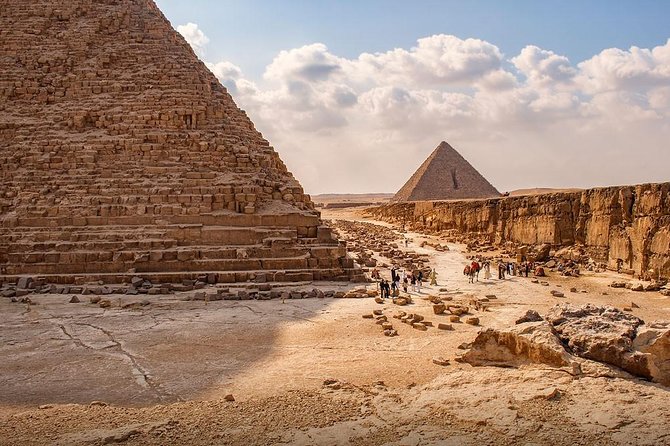
Dahshur is the most useful first stop for understanding how pyramid construction developed. It lies roughly 30 kilometers from Cairo and receives less attention than Giza, which gives the area a quieter feel in comparison.
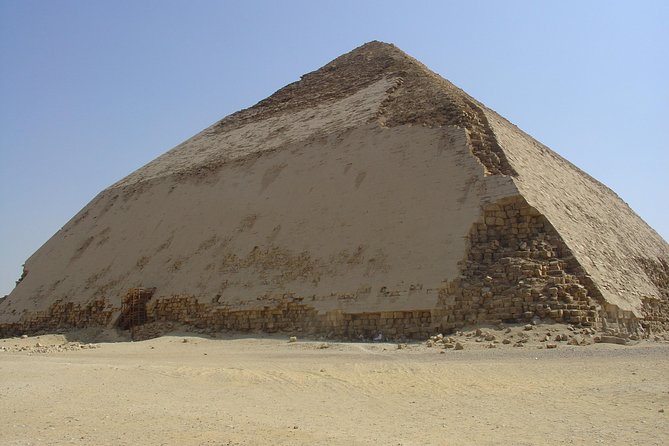
The main sight is the Bent Pyramid, built during the reign of Pharaoh Snefru. Its lower section rises at a steep angle, then the slope changes partway up. That unusual shape gives the pyramid its name and hints at the problems ancient builders faced when trying to create a tall, stable royal monument.
The change in angle is not a small decorative detail. It makes the pyramid easy to read from a distance. You can see that the builders adjusted their plan during construction, perhaps to reduce structural pressure or correct a design problem. The exact reason remains uncertain, so your guide may offer historical theories rather than a single final answer.
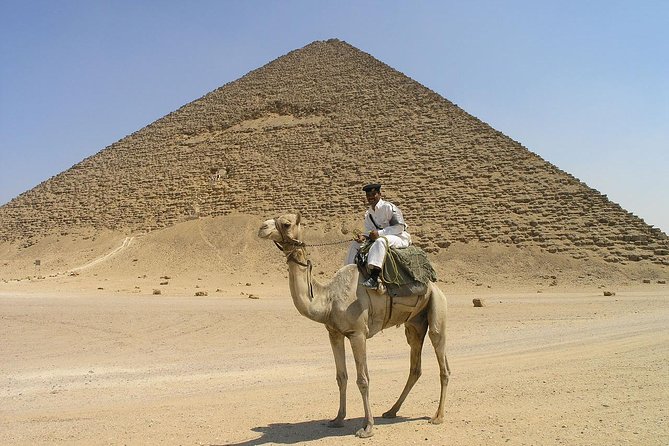
Dahshur also includes the Red Pyramid, another major monument associated with Snefru. The Red Pyramid is especially appealing if you want a more physical experience. One account describes passing through its narrow entrance passage, a route that requires bending and moving through a confined space.
That detail matters. Entering a pyramid is not like walking into a spacious museum hall. The passage may be narrow, low, warm, and uncomfortable, and some people may prefer to admire the exterior. If you do go inside, wear practical clothing and consider your comfort with enclosed spaces.
The interior visit is optional in the sense that entrance fees are not included and you are not required to enter every structure. Ask your guide what is open and what additional ticket is needed on the day.
Dahshur’s value is not just visual. It lets you look at ancient construction as a process of testing and adjustment. The Bent Pyramid shows a design change in plain sight, while the Red Pyramid represents a more settled form.
Saqqara and Djoser’s Step Pyramid
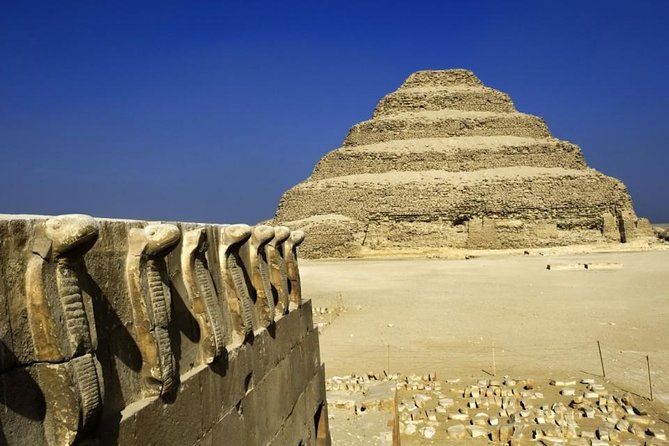
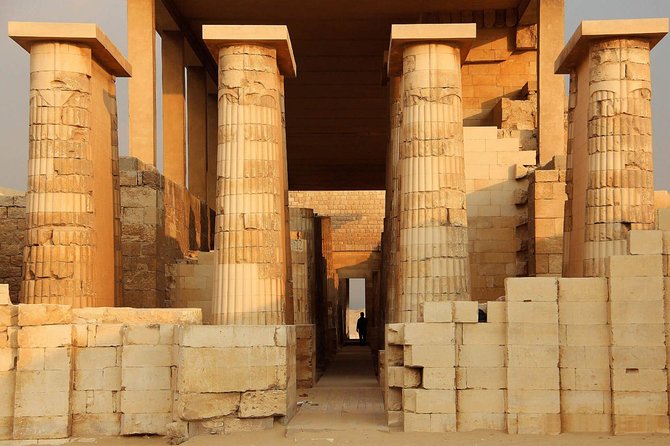
Saqqara brings you to another important stage in Egyptian architecture: the Step Pyramid of Djoser. It is linked with Pharaoh Djoser of the Third Dynasty and is described as Egypt’s first pyramid.
Before Djoser, royal burials were associated with other forms and locations. At Saqqara, the tomb became a large stepped structure made from layers that rise toward the sky. The result looks different from the smooth-sided pyramids at Giza, and that difference is exactly why the stop belongs on this route.
I find Saqqara valuable because it gives you a clear midpoint in the story. Dahshur shows experimentation, Saqqara shows the step-pyramid concept, and Giza shows the grand smooth-sided form that most people picture when they think of Egypt.
The Saqqara visit is not limited to one photograph of Djoser’s monument. The site also includes tombs with painted scenes and hieroglyphs. One account describes seeing wall drawings and the hieroglyphs of an ancient pharaoh’s accountant. These details can be more intimate than the giant pyramids because they show daily life, work, offerings, and written records.
Your guide is especially important here. A large monument can be impressive but hard to interpret without context. A good Egyptologist can explain what you are looking at, point out the meaning of carvings, and connect the site to the monuments you have already seen.
Saqqara also involves walking over an archaeological site, so moderate physical fitness is recommended. You should expect uneven ground, heat, and time on your feet. The supplied information does not give a precise walking distance, so anyone with mobility concerns should ask the operator for current details before booking.
Giza: the grand finale
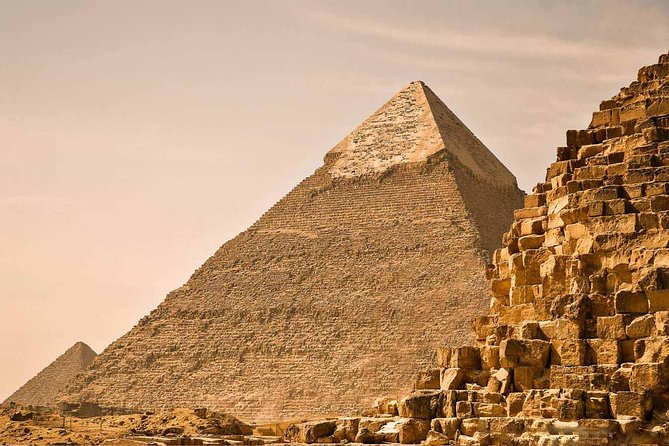
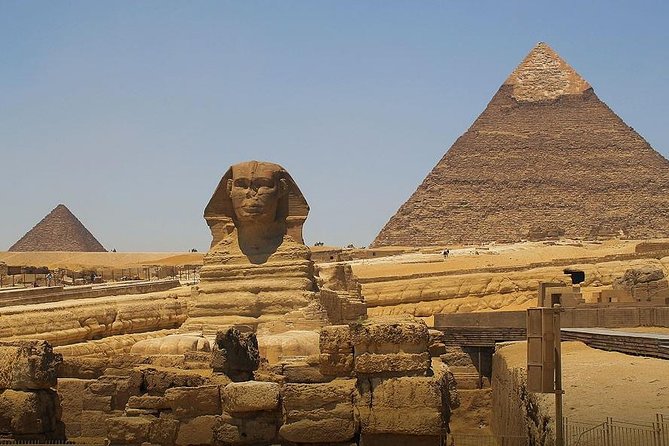
Giza is the emotional high point for most people. Here you see the three pyramids associated with Khufu, Khafre, and Menkaure, along with the Sphinx.
Khufu’s pyramid is the largest and most famous of the three. Khafre’s pyramid often appears taller because it sits on higher ground and retains some casing near its top. Menkaure’s pyramid is smaller, but it completes the royal group and helps you compare scale.
The guide will explain that these structures served as royal tombs. That basic fact is easy to overlook when you are standing beside stones of such enormous size. The real value of the visit comes from linking the monument to the people, beliefs, labor, and planning behind it.
The Sphinx adds a different mood. Instead of a geometric pyramid, you see a carved creature with a human head and lion’s body. It is a familiar image, yet viewing it as part of the Giza complex gives it more meaning than seeing it in a book or on a souvenir.
The tour allows about two hours at Giza. That is enough for the main viewpoints and the Sphinx, but it may not be enough for every optional activity, interior visit, and extended photo stop. If entering a pyramid is a priority, ask how that will affect the rest of the schedule.
One account describes the inside of a Giza pyramid as narrow, low-ceilinged, and poorly ventilated. That is useful practical advice. The exterior views are the part most people treasure, and entering is not essential to understand the site. If you dislike tight spaces, you can still have a strong Giza visit without going inside.
Camel rides and other extras appear in some of the tour experiences, but they are not included in the stated package. Confirm the cost before agreeing to anything beyond the listed service.
More ways to see the Pyramids and the Sphinx:
- Cairo: Pyramids & Great Sphinx Private Tour with Camel Ride
★ 4.9 · 6,335 reviews - Tour to Giza Pyramids and The Egyptian Museum
★ 5.0 · 6,016 reviews - Cairo 8 Hour Private Tour of Pyramids, Egyptian Museum and Bazaar
★ 5.0 · 2,931 reviews - From Cairo: Half-Day Tour to Pyramids of Giza and the Sphinx
★ 4.6 · 2,891 reviews
Guides who make the stones readable
A guide can make or break a pyramid day. The strongest praise here goes to the Egyptologists who explain the monuments with stories, dates, legends, and clear comparisons.
Zizou is repeatedly described as an excellent guide for a first visit. His background in Egyptology, interest in language and legends, and lively explanations helped visitors connect the sites to ancient culture. Hosni is also praised for making the history enjoyable and for adjusting the plan around the places the group most wanted to see.
Other named guides include Mahmoud, Mahmoud Badr, Emad G, Ahmed, Galal, Emile, and Shawky. The guide you receive will depend on the booking and language arrangements, but the pattern is encouraging: clear explanations, polite service, patience, and a willingness to answer questions.
You should still be specific about what interests you. Tell your guide if you care most about architecture, royal burial customs, hieroglyphs, photography, or entering a pyramid. The itinerary covers a lot, and a short conversation at the start can help you use your time well.
One useful criticism is that more explanation during the drives would help. The time between sites is not just dead time. It is a chance to explain the next monument, the surrounding area, and how the stops fit together. If you want more commentary in the vehicle, ask for it.
Transport, lunch, and the small-group format
Pickup and drop-off are offered at Cairo and Giza hotels. That is a practical advantage in a city where arranging transport to several archaeological sites can take effort and negotiation.
The vehicle is air-conditioned, and bottled water is provided. Both matter in Egypt, where you may be outside for long periods. The exact vehicle can vary, but one account describes a spacious van.
Drivers also receive strong praise. Omar, Mohammed, Ramadan, Waled, Salah, and other drivers are described as punctual, polite, and careful. Safe, steady driving matters because the archaeological sites are separated by city roads and open stretches beyond central Cairo.
The group limit is 15 people. That is small enough to hear the guide more easily than in a large coach group, but it is not a private tour. If you want complete control over stops and timing, a private option may be more suitable. Several of the positive experiences described were private tours, so do not assume every benefit of those arrangements applies to the standard small-group booking.
Lunch at a local restaurant is included. The food is described positively in the supplied accounts, including one mention of a delicious oriental lunch. The exact menu and restaurant are not specified, so treat lunch as a convenient included meal rather than a fixed culinary experience.
Is $46 a good value?
At $46 per person, the tour offers a useful bundle: hotel pickup and drop-off, air-conditioned transport, bottled water, a professional Egyptologist, and lunch. For someone who wants the three major pyramid areas without piecing together taxis, guides, and meals, that is a fair starting price.
The price does not include entrance fees. This is the main point to clarify before booking because the actual cost depends on which monuments and interiors you enter. Tips and extras are also excluded.
I would compare the price with the cost of arranging a driver and guide separately, not with the ticket price alone. The route covers several sites, and the transport between them has real value. You are paying for coordination as well as access to a guide.
The tour receives a 4.9 rating from 20 reviews, with 100 percent recommending it. That is a strong signal, though the sample is small. The most consistent strengths are punctual pickup, smooth arrangements, good drivers, and guides who explain the sites well.
Who should book this pyramid tour?
I would choose this tour if you are visiting Cairo for the first time and want the main pyramids in a single organized day. It suits people who prefer having transport, a guide, and lunch handled for them.
It is also a good fit if you want more than the standard Giza visit. Saqqara and Dahshur give you the architectural story that Giza alone cannot provide.
Families and older visitors should consider the physical side. The tour requires a moderate fitness level, and some pyramid interiors involve narrow, low passages. You can ask your guide about skipping an interior or adjusting the pace, but the site visits still involve walking and outdoor exposure.
You may prefer a private tour if you need a highly flexible schedule, have special mobility needs, or want to spend most of the day inside one pyramid area. A small group is more personal than a large coach, but it still follows a shared plan.
Cancellations are free up to 24 hours before the start time. Inside that 24-hour window, refunds are not available, and poor weather may lead to a different date or a full refund.
Final decision: book it for the full pyramid story
Book this tour if you want the pyramids explained in a sensible order rather than viewed as isolated monuments. Dahshur gives you the Bent Pyramid and Red Pyramid, Saqqara provides Djoser’s Step Pyramid and decorated tombs, and Giza delivers Khufu, Khafre, Menkaure, and the Sphinx.
The $46 price is attractive, but remember to add admission fees and tips. Expect a long day despite the five-hour estimate, and prepare for heat, walking, and possibly cramped pyramid passages.
For a first Cairo visit, I think the route offers strong value. You get the essential sights, the earlier stages of pyramid design, reliable hotel transport, lunch, and a guide who can turn a pile of ancient stones into a story you can follow.
FAQ
Where does the tour take place?
The tour takes place in Cairo and covers the Pyramids of Giza, the Sphinx, Dahshur, and Saqqara.
Does the tour include hotel pickup?
Yes. Hotel pickup and drop-off are included for hotels in Cairo and Giza.
How much does the tour cost?
The stated price is $46 per person.
Are entrance fees included?
No. Entrance fees are not included and must be paid separately.
How long does the tour last?
The listed duration is approximately five hours. The site schedule and driving time may make the outing last longer, and some descriptions refer to it as a full-day activity.
What is included in the price?
The price includes hotel pickup and drop-off, bottled water, transport in an air-conditioned coach, a professional Egyptologist guide, and lunch at a local restaurant.
How many people can join the group?
The maximum group size is 15 people.
Which pyramids can you see at Giza?
You can see the pyramids of Khufu, Khafre, and Menkaure, as well as the Sphinx.
Can you enter the pyramids?
Interior entry is possible where available, but entrance fees are not included. Some passages are narrow, low, and poorly ventilated.
What is the cancellation policy?
You can cancel for a full refund up to 24 hours before the experience starts. Cancellations or changes made less than 24 hours before the start time are not refunded or accepted.
Newly listed around Cairo
- Full Day Trip from Cairo to Luxor★ 5.0 · 16 reviews
- Private guide’s trip to Giza pyramids, Great sphinx valley temple★ 5.0 · 37 reviews
- Private half Day Tour to the Great 3 Pyramids of Egypt★ 5.0 · 15 reviews
- VIP Tour inside Giza Pyramids★ 4.5 · 103 reviews
- Full-Day Private Tour to Giza Pyramids, Sphinx, Memphis & Saqqara★ 5.0 · 106 reviews
- Unique Tour to The Grand Egyptian Museum and 12 main galleries★ 4.0 · 38 reviews
- Elite Boats Tour in Cairo & Giza with Drinks Included★ 4.5 · 15 reviews
- Sunset & Night Open Air Nile Cruise in Cairo & Giza★ 5.0 · 158 reviews
Giza Pyramids Tours, compared.
Pyramids & Great Sphinx Private Tour with Camel Ride
Read our review →
Tour to Giza Pyramids and The Egyptian Museum
Read our review →
VIP All inclusive Best of the best Giza Pyramids,Sakkara,Memphis
Read our review →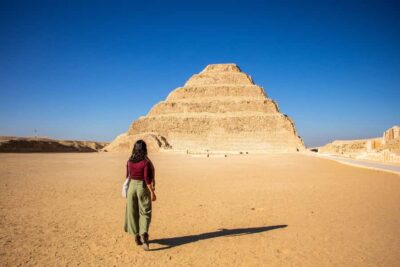
Pyramids of Giza, Sphinx, Saqqara & Memphis Tour
Read our review →
Cairo 8 Hour Private Tour of Pyramids, Egyptian Museum and Bazaar
Read our review →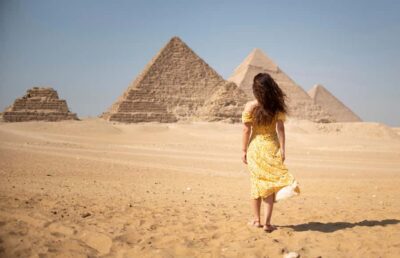
Half-Day Tour to Pyramids of Giza and the Sphinx
Read our review →
Private ViP all-inclusive Giza Pyramids,Sphinx,Inside Pyramid
Read our review →Browse the lists this tour appears in