
Reviewed · GIZA PYRAMIDS TOURS
Cairo Layover Tours Visit Giza Pyramids Memphis Sakkara Dahshur Pyramids & Bazaar
Make your layover count. This 10-hour private Cairo tour turns airport downtime into a fast tour of Egypt’s best-known ancient sites, with visits to Giza, Saqqara, Dahshur, Memphis, and Khan El Khalili. You get private air-conditioned transport, a guide, bottled water, and a ride back to Cairo International Airport.
I like the broad mix. You see the famous pyramids, but you also reach quieter and older sites that explain how pyramid building developed. I also like the private setup, which gives your group its own vehicle rather than placing you on a large coach.
The main catch is the pace. Eleven listed stops in about 10 hours leaves little room to linger, eat, or absorb every site slowly. You should also confirm exactly which entrance fees are covered, since the tour information says both that entry fees are included and that only basic-area admission is included.
- A full pyramid story: Giza, Saqqara, and Dahshur show the progression from early step pyramids to later smooth-sided designs.
- Private airport transport: Round-trip transfers by private, air-conditioned vehicle make this practical for a long layover.
- More than Giza: Memphis, the Pyramid of Unas, the Pyramid of Teti, and the Mastaba of Ti add depth beyond the standard postcard stops.
- A real Cairo finish: Khan El Khalili gives you time for perfumes, brassware, leather, silver, gold, antiques, and other local goods.
- Helpful driver service: Driver Ashraf is praised for thoughtful care, including keeping bottled water cold and opening doors at each stop.
- Shopping is built in: Expect 20-minute visits to perfume, cotton, papyrus, and carpet outlets, which may appeal to shoppers but reduce sightseeing time.
In This Review
- Why This Layover Tour Makes Sense
- Giza in Two Hours: The Big Three and the Sphinx
- Thirty Minutes at Each Pyramid
- Saqqara and the Step Pyramid of Djoser
- The Pyramid Texts Inside Unas
- Teti and the Mastaba of Ti
- Dahshur’s Bent and Red Pyramids
- Memphis and the Colossal Ramses II
- Khan El Khalili After the Ancient Sites
- What the $90 Price Delivers
- The Private Vehicle and Pace
- Who Should Book This Cairo Layover Tour?
- Should You Book It?
- FAQ
- How long does the Cairo layover tour last?
- Does the tour pick me up and return me to Cairo International Airport?
- Is this a private tour?
- Which ancient sites are included in the route?
- Is lunch included?
- Are entrance fees included?
- Can I cancel for a full refund?
Why This Layover Tour Makes Sense
Cairo airport layovers can be awkward. You have enough time to leave the terminal, but not enough time for a relaxed, independent day with uncertain taxis and city traffic. This tour solves the main problem by arranging airport pickup, a private vehicle, a guide, and a return transfer.
The day begins at 8:00 a.m. and lasts about 10 hours. That is a long outing, but Cairo’s ancient sites are spread across the western side of the city and farther south along the Nile Valley. A private vehicle matters here because you are not wasting time figuring out every connection.
I especially like the route’s historical range. Giza is the great headline, yet Saqqara and Dahshur help you understand what came before and after the famous pyramids. Memphis adds a capital city, while Khan El Khalili brings you back to present-day Cairo.
Still, this is not a slow archaeological study tour. The planned visits include several 30-minute stops, and the full schedule can feel packed. You need a long enough layover to allow for airport procedures, traffic, and possible delays. The advertised return to the airport is useful, but no tour can remove Cairo traffic from the equation.
Giza in Two Hours: The Big Three and the Sphinx
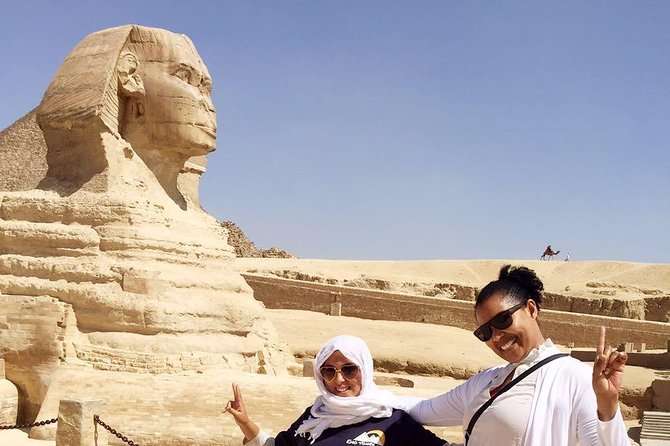
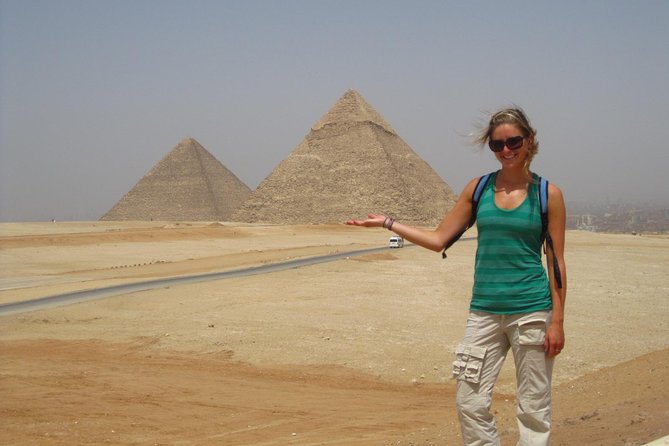
Giza receives the longest single block of time, about two hours. That makes sense. The plateau contains the Great Pyramid of Khufu, the Pyramid of Khafre, the Pyramid of Menkaure, the Sphinx, and the Valley Temple connected with Khafre.
The three main pyramids give you different impressions. Khufu is the largest and most famous. Khafre often appears taller from certain viewpoints because it sits on higher ground and retains some of its original casing near the top. Menkaure is smaller, but its complex helps show that the royal cemetery was not just a single pyramid. Each complex included temples, causeways, and burial structures.
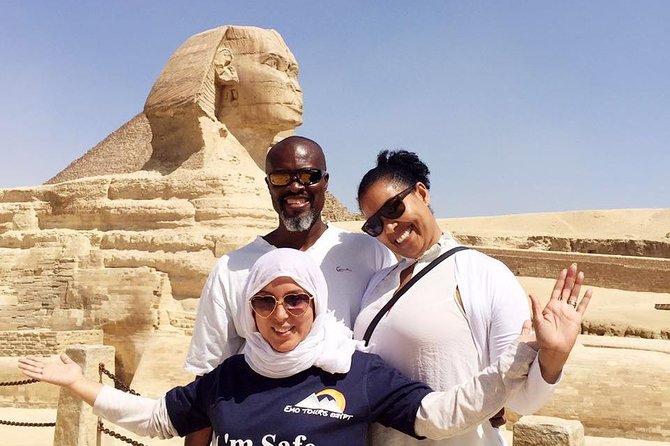
The Valley Temple is tied to the mummification of Khafre. Its massive stonework gives you a sense of the engineering required to prepare and honor a king. The Sphinx is close by, with a lion’s body and the head of Khafre, and it remains one of the easiest places to get an iconic photograph.
The tour details list the general Giza Plateau visit as free, while the individual pyramid entries are marked as not included. That distinction matters. Basic access to the area may be covered, but entering the interiors or special sections can cost extra. Ask your guide which tickets are included before you decide to go inside.
You should also expect heat, stone surfaces, and plenty of open ground. Comfortable shoes, water, and a hat are sensible. One bottle of water is included, and the extra care described by Lucinda, including cold water and assistance at stops from driver Ashraf, is a welcome touch on a hot day.
More Saqqara, Memphis and Dahshur days:
- Private Tour to explore Giza Pyramids – Saqqara -Memphis
★ 5.0 · 294 reviews - Unbeatable tour (Giza Pyramids,Sphinx,Sakkara,Memphis)
★ 5.0 · 123 reviews - Giza Pyramids – Sphinx & Saqqara & Memphis
★ 5.0 · 114 reviews
Thirty Minutes at Each Pyramid
The schedule gives about 30 minutes to Khufu, Khafre, and Menkaure. That is enough to hear the main story, walk to viewpoints, and take photographs. It is not enough for a long exploration of every temple or an unhurried visit inside a pyramid.
Khufu’s valley temple lies beneath the modern village of Nazlet el-Samman and has not been fully excavated. That detail helps explain why a guide is useful. What you see on the ground is only part of the original complex, and the lost causeway once connected the valley temple with the upper buildings.
Khafre’s complex is more extensive in the historical record. It included a valley temple, the Sphinx Temple, a causeway, a mortuary temple, and the pyramid itself. Several statues of Khafre were found in the valley temple, including pieces discovered during excavations in the nineteenth and early twentieth centuries.
Menkaure’s complex also included a valley temple, causeway, mortuary temple, and pyramid. Statues found there help connect the bare stone monuments with the people and rituals they served.
I would treat these short visits as a focused introduction. Listen for the differences between a pyramid, a mortuary temple, a valley temple, and a causeway. Those terms turn a collection of giant stones into a functioning royal burial complex.
Saqqara and the Step Pyramid of Djoser
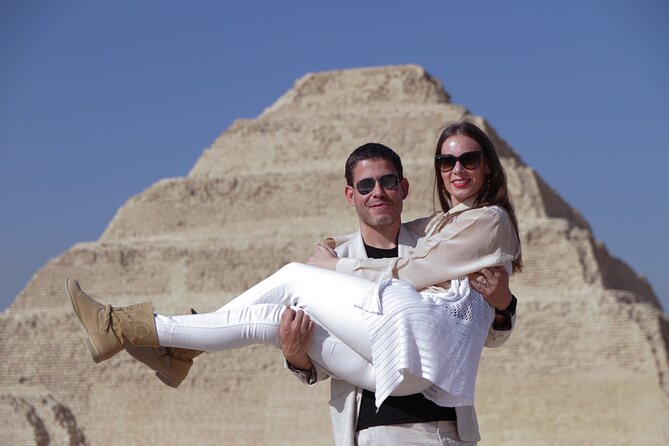
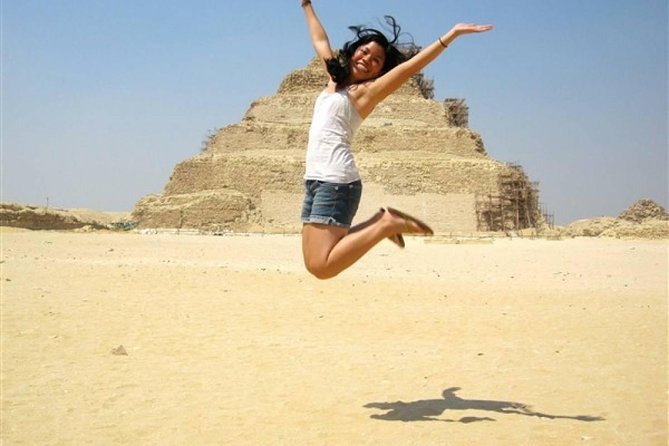
The drive to Saqqara takes you about 27 kilometers southwest of Cairo. The site is important because it shows an earlier stage in pyramid design. The Step Pyramid was built for King Djoser and developed from the older mastaba form into the stacked design that later became the smooth pyramid.
You get about an hour here. That is enough to see the main monument and hear how Egyptian builders changed the shape of royal tombs. Saqqara also contains several important burial sites, so the stop can feel more varied than Giza.
The tour includes the Pyramid of Unas, the Pyramid of Teti, and the Mastaba of Ti as separate visits. These sites are a major reason to choose this outing over a simple Giza transfer. You are not just checking off the three most famous pyramids. You are seeing tombs with different designs, dates, and decoration.
Entrance fees are listed as separate or not included for Saqqara. The general inclusion section says entry fees are included, with basic-area access specified elsewhere. Get a clear explanation of the ticket arrangement before the day begins, especially if you want to enter underground chambers.
The Pyramid Texts Inside Unas
The Pyramid of Unas is smaller than the great royal pyramids, but it has an important feature inside. Its underground chambers contain Pyramid Texts, spells intended to help the king in the afterlife.
These inscriptions were first placed in a pyramid at Unas’s burial complex. The tradition continued in later pyramids and eventually influenced funerary texts such as the Coffin Texts and the Book of the Dead.
The planned visit lasts about 30 minutes. That is brief, but the site can add real meaning to the day. At Giza, the scale dominates. At Unas, the written words and underground spaces point toward the beliefs behind the monuments.
If you enter, follow the guide’s instructions and be ready for confined passages. The information supplied does not specify interior access or extra ticket arrangements, so confirm those details on the day.
More ways to see the Pyramids and the Sphinx:
- Private guided tour to Giza Pyramids, and Great Sphinx
★ 5.0 · 1,755 reviews - VIP Giza Pyramids,Sphinx,ATV bike,CamelRide,Shopping&DinnerCruise
★ 5.0 · 704 reviews - From Hurghada: Pyramids and Egyptian Museum Tour & Boat Ride
★ 4.4 · 381 reviews - Sharm El-Sheikh: Full-Day Tour of Cairo and Pyramids by Bus
★ 4.8 · 237 reviews
Teti and the Mastaba of Ti
The Pyramid of Teti also receives about 30 minutes. It was built as the burial place of Pharaoh Teti and gives you another chance to see how Old Kingdom royal tombs were planned.
The Mastaba of Ti is different. A mastaba is a rectangular tomb with a flat roof, and Ti’s tomb is known for scenes of everyday life carved or painted on its walls. These images can show work, food production, animals, and household activity, giving you a more human view of ancient Egypt than a pyramid alone.
The mastaba was discovered by Auguste Mariette and contains two serdabs. A serdab is a concealed room associated with statues of the deceased. For me, this stop has special value because it shifts attention from kings and monuments to ordinary work and daily routines.
Again, 30 minutes is an introduction rather than a full study. If decorated tomb scenes are your main interest, you may want to ask the guide to focus the visit rather than spreading your attention across every available room.
Dahshur’s Bent and Red Pyramids
Dahshur lies about 40 kilometers south of Cairo on the Nile’s west bank. The royal necropolis is known for the Bent Pyramid and the Red Pyramid, two of Egypt’s oldest, largest, and best-preserved pyramids.
The Bent Pyramid is famous for its change in angle. Its lower section rises steeply, then the upper section shifts to a gentler slope. The design gives you a visible record of builders adjusting their approach during the development of pyramid construction.
The Red Pyramid is another key step toward the smooth-sided form associated with the later pyramids at Giza. The Dahshur stop lasts about an hour, giving you more time than the individual Giza pyramid visits.
This area may feel less familiar than Giza, which is part of its appeal. The tradeoff is that it adds more driving to an already full day. You should choose Dahshur because you want the history of pyramid design, not because you expect a leisurely desert visit.
Memphis and the Colossal Ramses II
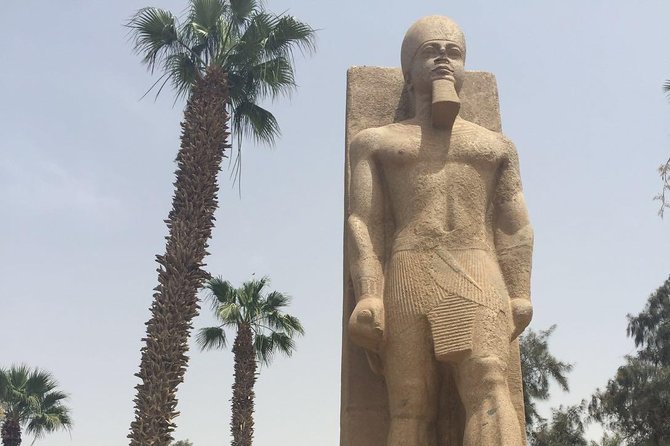
Memphis was the ancient capital of Egypt and dates back to about 3100 B.C. The visit includes the colossal statue of Ramses II and the great Alabaster Sphinx.
The Memphis stop lasts an hour. After the open spaces of Giza and Dahshur, this museum-style setting gives you another way to read ancient Egypt. Monumental sculpture and royal images show how power was presented in the capital.
The colossal Ramses II statue is a striking feature. Its size makes the political message clear: the king was meant to be seen as larger than ordinary life. The Alabaster Sphinx offers a different look at the same tradition of guardian figures and royal symbolism.
Memphis is sometimes skipped by short Cairo excursions because it requires extra driving. Including it makes this tour better suited to someone who wants a broad ancient Egypt sampler during a single layover.
Khan El Khalili After the Ancient Sites
The final major stop is Khan El Khalili Bazaar, with about an hour to browse. Its shops sell brassware, copper, perfumes, leather, silver, gold, antiques, and other goods.
This is a useful change of pace after the monuments. You can look at objects made for daily use, gifts, or decoration, and you get a taste of Cairo’s commercial life. The market is also a place to practice polite bargaining and to compare quality before buying.
The tour includes planned 20-minute stops at Paradise Perfumes and Flower Cotton, Key of Life Papyrus, and a handmade carpet school. You may see traditional papyrus making, Egyptian cotton, natural oils, and rug weaving.
These stops are not secret. They are part of the arranged program, so shoppers may enjoy them. If your priority is archaeology, they can feel like sales visits and use time that could otherwise go to a monument. Ask how much time is available at each stop, and do not feel obliged to buy.
The tour information also refers to government stops for souvenirs with quality guarantees. Treat that as an opportunity to inspect goods carefully, compare prices, and buy only what you genuinely want.
What the $90 Price Delivers
At $90 per person, the value depends on your layover and group size. Private airport pickup and drop-off, a private air-conditioned vehicle, a guide, bottled water, and access to a long route are meaningful inclusions. Arranging all of that independently would take time and would leave you managing transport and airport timing yourself.
The price is strongest when several people share the vehicle and want the same full-day plan. Group discounts may improve the deal further. For one person, the cost is still defensible if a safe, organized airport return is your main concern.
Lunch is optional and not included. Tipping is also not included. Plan for both if you want a meal or wish to thank the guide and driver.
The unclear ticket wording is the one point I would settle before booking. The details say entry fees are included, then specify basic-area admission and mark many individual stops as not included. Ask in writing which sites, pyramid interiors, tombs, and special areas require extra payment.
The Private Vehicle and Pace
Private transport is the backbone of this experience. The vehicle is described as a late-model, air-conditioned car, and the tour includes pickup and drop-off at Cairo International Airport. You do not share the day with a large group, and only your own party participates.
That gives you some flexibility, but the schedule remains ambitious. Giza, Saqqara, Dahshur, Memphis, several individual tombs, Khan El Khalili, and shopping stops cover a lot of ground. A good guide can help you focus, but you cannot see every detail at length.
The high rating of 4.8 from 22 ratings and the 91 percent recommendation figure suggest strong satisfaction, especially with the service. The praise for Ashraf is specific: cold bottled water, opened doors, and attentive care at each stop. Those small actions matter when you are tired, jet-lagged, or returning to an airport.
Start with your passport, flight details, water, sun protection, and comfortable shoes. Keep your return flight timing visible to the guide and driver. The tour is designed around airport transfer, but you remain responsible for allowing enough time to check in and pass airport procedures.
Who Should Book This Cairo Layover Tour?
I would choose this tour if you have a long layover and want to see far more than Giza. It suits first-time visitors who want the main pyramid photographs plus Saqqara, Dahshur, Memphis, and a Cairo market in one organized day.
It also works well for families or small groups that value a private vehicle. The private format can be easier than dividing up in taxis, and group discounts may make the price more attractive.
I would hesitate if you want a quiet, museum-heavy day or if you prefer to spend half a day at one archaeological site. The route is broad, the stops are short, and the shopping visits may not appeal to everyone.
Free cancellation is available when you cancel at least 24 hours before the scheduled start time. Changes or cancellations made within 24 hours are not accepted for a refund.
Should You Book It?
Book it if your layover is long enough for a 10-hour outing plus airport time, and you want a wide introduction to ancient Egypt with private transport. The strongest parts are the range of sites, the dedicated vehicle, and the return to your terminal.
Before paying, confirm the exact ticket inclusions, interior access, meal arrangement, and airport timing. If those points are clear, this is a practical way to turn an inconvenient layover into a full day of pyramids, tombs, ancient capitals, and Cairo shopping.
FAQ
How long does the Cairo layover tour last?
The tour lasts approximately 10 hours and begins at 8:00 a.m.
Does the tour pick me up and return me to Cairo International Airport?
Yes. Pickup and drop-off at the airport are included, and the tour ends with a transfer back to Cairo International Airport.
Is this a private tour?
Yes. The activity is private, and only your group participates.
Which ancient sites are included in the route?
The route includes the Giza Plateau, the pyramids of Khufu, Khafre, and Menkaure, the Great Sphinx, Saqqara, the Bent and Red Pyramids at Dahshur, Memphis, the Pyramid of Unas, the Pyramid of Teti, and the Mastaba of Ti.
Is lunch included?
No. Lunch is optional and is not included in the listed price.
Are entrance fees included?
The tour information says entry fees are included but also specifies basic-area admission and marks several individual attractions as not included. Confirm the exact ticket coverage before booking.
Can I cancel for a full refund?
Yes. You can receive a full refund if you cancel at least 24 hours before the experience start time. Cancellations or changes made less than 24 hours in advance are not accepted for a refund.
More Shopping Tours in Giza
- All inclusive :Pyramids, Sphinx ,lunch, ATV BIKE ,CAMEL,Shopping
★ 5.0 · 125 reviews - Giza Pyramids private tour, ATV bike, Lunch, Camel ride, shopping
★ 5.0 · 96 reviews - Private tour to Giza Pyramids, Lunch, Camel Ride & Shopping tour
★ 5.0 · 86 reviews - Private Half Day Pyramids Giza, Sphinx with Lunch and shopping
★ 5.0 · 58 reviews
More Markets in Giza
- All inclusive private tour Egyptian Museum/Coptic Cairo/Bazaar
★ 5.0 · 95 reviews - Pyramids of Giza Egyptian Museum Sphinx and Khan El Khalili Bazaar
★ 5.0 · 54 reviews - Private Tour: Giza Pyramids, Museum, Bazaar & Lunch Included
★ 5.0 · 47 reviews - 8-Hours private tour of Giza pyramids, Egyptian museum&Bazaar
★ 5.0 · 40 reviews
Newly listed around Giza
- Full Day Trip from Cairo to Luxor★ 5.0 · 16 reviews
- Private guide’s trip to Giza pyramids, Great sphinx valley temple★ 5.0 · 37 reviews
- Private half Day Tour to the Great 3 Pyramids of Egypt★ 5.0 · 15 reviews
- VIP Tour inside Giza Pyramids★ 4.5 · 103 reviews
- Full-Day Private Tour to Giza Pyramids, Sphinx, Memphis & Saqqara★ 5.0 · 106 reviews
- Unique Tour to The Grand Egyptian Museum and 12 main galleries★ 4.0 · 38 reviews
- Elite Boats Tour in Cairo & Giza with Drinks Included★ 4.5 · 15 reviews
- Sunset & Night Open Air Nile Cruise in Cairo & Giza★ 5.0 · 158 reviews
Giza Pyramids Tours, compared.
Pyramids & Great Sphinx Private Tour with Camel Ride
Read our review →
Tour to Giza Pyramids and The Egyptian Museum
Read our review →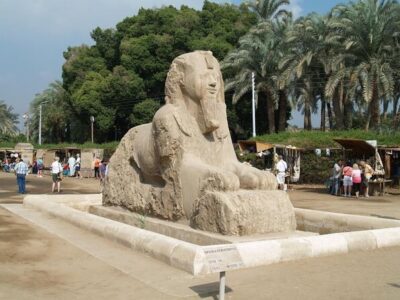
VIP All inclusive Best of the best Giza Pyramids,Sakkara,Memphis
Read our review →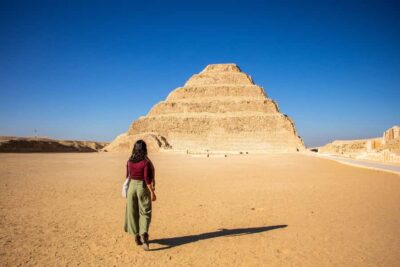
Pyramids of Giza, Sphinx, Saqqara & Memphis Tour
Read our review →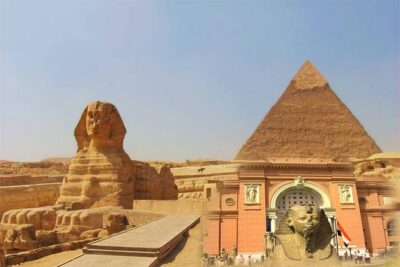
Cairo 8 Hour Private Tour of Pyramids, Egyptian Museum and Bazaar
Read our review →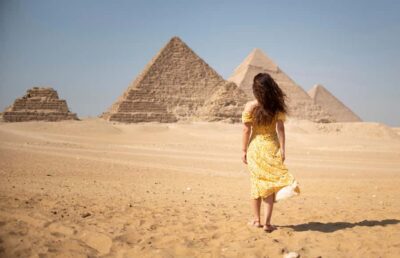
Half-Day Tour to Pyramids of Giza and the Sphinx
Read our review →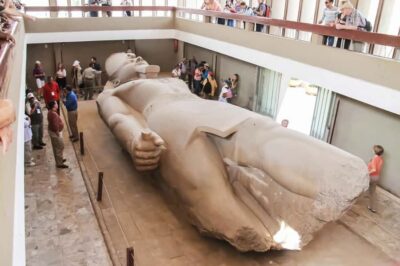
Private ViP all-inclusive Giza Pyramids,Sphinx,Inside Pyramid
Read our review →Browse the lists this tour appears in