
Reviewed · 2-DAY EXPERIENCES
2 Days best of Cairo & Giza private guided tour
Cairo rewards a well-planned first look. This two-day private tour brings together the city’s biggest ancient, Islamic, and Christian sights, from the Great Pyramid and Sphinx to Saqqara, the Egyptian Museum, Coptic Cairo, and Khan El-Khalili. It is a strong choice if you have limited time and want one guide, one air-conditioned vehicle, and a clear plan.
I like the private format, which gives your group its own guide and transport instead of tying you to a large coach. I also like the range: you see pyramid fields, ancient capitals, royal treasures, medieval defenses, churches, mosques, and a traditional bazaar in only two days.
The main drawback is the pace. Two days is enough for a broad introduction, but not enough for slow museum study or long, unhurried visits. The price also excludes extra tickets for entering the pyramids and visiting the Solar Boat Museum, so those costs need to be considered before booking.
In This Review
- Key points to know before booking
- Why this two-day plan works
- Day one: the Great Pyramid and the Giza plateau
- Memphis: Egypt’s first great capital
- Saqqara and the Step Pyramid
- Day two: the Egyptian Museum and Tutankhamun’s treasures
- Coptic Cairo and the story of Old Cairo
- Saladin Citadel and the Muhammad Ali Mosque
- Khan El-Khalili: a final hour in Islamic Cairo
- Guides, vehicles, and the private-tour advantage
- Price, included costs, and what is extra
- Who should book this Cairo tour?
- Final decision
- FAQ
- What is included in the two-day Cairo tour?
- Are tickets to enter the pyramids included?
- Is the Solar Boat Museum included?
- What time does the tour start?
- Is this a private tour?
- Can I cancel for a full refund?
Key points to know before booking
- The first day links three major ancient sites: Giza, Memphis, and Saqqara, with about six hours of planned sightseeing before returning to your starting point.
- The second day shifts from pharaohs to living Cairo: the Egyptian Museum, Coptic churches, Saladin Citadel, Muhammad Ali Mosque, and Khan El-Khalili.
- A private Egyptologist guide is included: guide names associated with the operating team include Ahmed, Ahmed Farahat, Mostafa, Mohammed, and Osama, though your assigned guide may differ.
- The Great Pyramid interior costs extra: standard entrance fees cover the listed sights, but additional pyramid tickets and the Solar Boat Museum are not included.
- Transport is designed for Cairo traffic: private air-conditioned transport with Wi-Fi and bottled water is provided.
- The tour suits a short Cairo stay: it is best for first-time visitors who want the headline sights covered efficiently rather than a slow, specialist archaeological tour.
Why this two-day plan works
Cairo can feel confusing at first. The city spreads across both banks of the Nile and reaches far beyond the famous pyramids. Distances, traffic, heat, and busy streets can make independent sightseeing tiring, especially when you are trying to fit Giza, Saqqara, the museum, and Old Cairo into a short stay.
This tour solves much of that problem by grouping the sights in a sensible way. Day one focuses on the ancient world around Giza and the old Memphis area. Day two stays closer to central Cairo and moves through the city’s Egyptian, Christian, Islamic, and commercial quarters.
You get private transportation, an air-conditioned vehicle, Wi-Fi on board, bottled water, snacks, entrance fees for the listed sights, and an Egyptologist guide who speaks your language. That package matters in Cairo. You are not only paying for sightseeing, but also for the time saved between sites and the help of someone who can explain what you are seeing.
The start time is 8:00 a.m. Both days are full, so I would treat this as a sightseeing mission, not a relaxed holiday outing. You will see a lot, but you should expect walking, sun, crowds, and plenty of information.
A few more Cairo outings to price up
- White & Black Desert tour 2 Days 1 night camping from Cairo.
★ 5.0 · 649 reviews - Cairo: 2-Day Bahariya Oasis Camp and Desert Tour
★ 4.9 · 616 reviews - White & Black desert camping tour 2 Days 1 night From Cairo
★ 5.0 · 467 reviews
Day one: the Great Pyramid and the Giza plateau
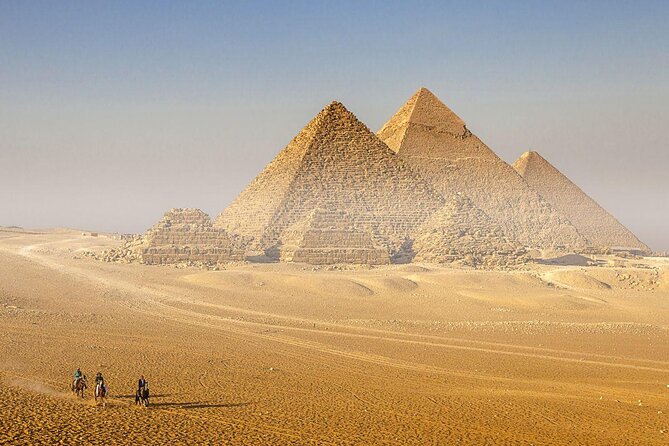
The tour begins at Giza, where the three main pyramids dominate the plateau. The Great Pyramid of Khufu, also called Cheops, is the first major stop. It was built during Egypt’s Fourth Dynasty and reached about 146 meters in its original form. The construction used more than two million stone blocks, making the scale difficult to grasp until you are standing beside it.
Your guide should help turn the monument from a famous photograph into a real place with purpose and context. You have time to walk around the Great Pyramid, then drive to a panoramic viewpoint where all three main pyramids can be seen together. This is also one of the better places for photographs, since the view gives you the pyramid group rather than a single structure.
The second pyramid, built for Khafre, still retains part of its original smooth outer casing near the top. The smaller Pyramid of Menkaure completes the familiar trio. The planned visit lasts about three hours, including the pyramid area, panoramic viewpoint, and Sphinx.
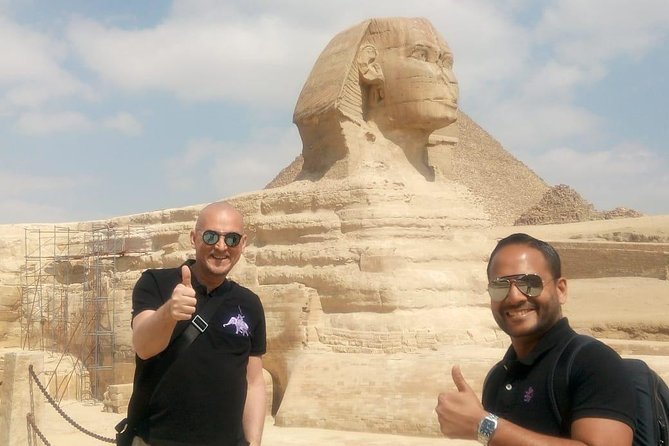
The Great Sphinx is the emotional centerpiece for many people. It has the body of a lion and a human head, and it lies beside the Valley Temple associated with Khafre. You get time to stand in front of it and take in the scale. The Sphinx area can be crowded, and the sun can be strong, so your water and snacks are useful here.
One practical point is easy to miss: the included entrance fees do not cover every possible interior visit. If you want to enter the Great Pyramid or another pyramid, you need an extra ticket. The Solar Boat Museum also costs extra. Ask your guide about availability and pricing before committing, since the basic tour price does not include those additions.
Memphis: Egypt’s first great capital
After Giza, the route continues to Memphis, about an hour of sightseeing. Memphis was the first capital of a unified Egypt and was known in ancient Egyptian as Mn-Nefer. Its ruins are less visually dramatic than Giza, but they help explain how the nearby pyramid fields fit into the wider political story.
The Memphis stop focuses on surviving sculpture and temple remains. You can see the huge fallen statue of Ramesses II, an alabaster sphinx, and works connected with Ptah, Nefertem, and Sekhmet. The site gives you a useful change of scale. At Giza, the pyramids dominate the horizon. At Memphis, the details are in carved stone, royal images, and fragments of a city that once governed Egypt.
I would not expect Memphis to feel like a complete ancient city. Much of the original capital is gone or buried, and the visit is short. Its value comes from the guide’s explanation and from seeing artifacts in the place connected with Memphis rather than only inside a museum.
Saqqara and the Step Pyramid
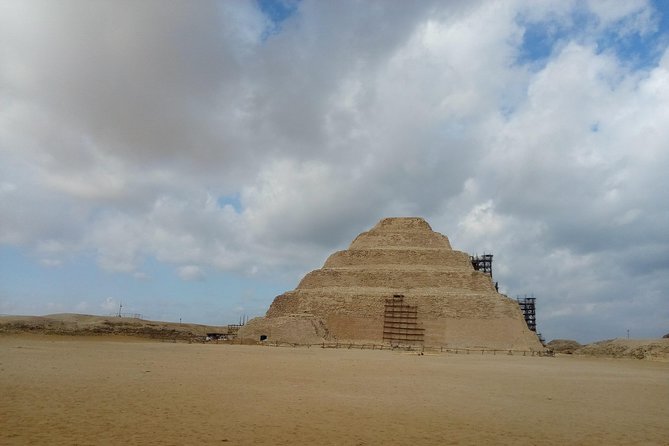
Saqqara is the most historically important stop of the afternoon. This large necropolis lies south of Giza and served the ancient capital of Memphis for centuries. Its burial grounds continued in use from the early dynastic period through the Greek and Roman eras.
The main attraction is the Step Pyramid of Djoser, ordered by King Djoser and designed by the architect Imhotep. It is widely regarded as the world’s earliest large pyramid and the first major Egyptian complex built in stone. The structure looks different from the smooth-sided pyramids at Giza because it was created as a series of rising stone layers.
The contrast makes the visit especially worthwhile. Giza shows the pyramid form at its most famous and monumental. Saqqara shows an earlier stage in its development, along with the wider religious and funerary complex around it.
The planned stop lasts about two hours. That is enough for a guided introduction, but Saqqara can reward more time if you enjoy archaeology, tomb decoration, and architectural detail. If your group wants to linger at every site, the schedule may feel tight. If you want to understand how Egyptian pyramid building developed, this is one of the most valuable parts of the first day.
After Saqqara, private transport takes you back to your starting point. The day is long, but the route is logical and avoids trying to mix Old Cairo with the pyramid area.
Same base, a completely different sort of day:
- Cairo: Pyramids & Great Sphinx Private Tour with Camel Ride
★ 4.9 · 6,335 reviews - Tour to Giza Pyramids and The Egyptian Museum
★ 5.0 · 6,016 reviews - VIP All inclusive Best of the best Giza Pyramids,Sakkara,Memphis
★ 5.0 · 3,164 reviews - From Cairo: Pyramids of Giza, Sphinx, Saqqara & Memphis Tour
★ 4.7 · 3,110 reviews
Day two: the Egyptian Museum and Tutankhamun’s treasures
The second day starts at the Egyptian Museum, one of the oldest major museums devoted to ancient Egyptian collections. The building dates to 1901, and the visit is planned for about two hours.
The collection covers Egyptian civilization from the prehistoric period through the Greek and Roman eras. The museum is associated with around 120,000 pieces, while the wider tour description gives a slightly different figure. Either way, two hours can only introduce you to the collection.
The most famous section is the treasure of Tutankhamun. Howard Carter discovered the young king’s tomb in 1922 in the Valley of the Kings, and the collection includes thousands of objects from that burial. Gold, furniture, jewelry, ceremonial items, and personal possessions show the wealth and craftsmanship placed in a royal tomb.
The museum can feel crowded and visually overwhelming. That is where a good guide matters. You will get more from the visit if you choose a few major objects and listen to the story behind them instead of trying to see everything. Two hours is a sensible first visit, but not enough for someone who wants to study every gallery.
Some famous Tutankhamun objects may be displayed elsewhere depending on museum arrangements, so it is sensible to ask your guide what is currently on view. The tour promises a museum visit and historical interpretation, not a private, quiet gallery experience.
Coptic Cairo and the story of Old Cairo
From the museum, the route continues to Coptic Cairo, a district of Old Cairo with churches, the remains of the Babylon Fortress, and other historic sites. The visit lasts about two hours, giving you time to see several important Christian landmarks.
The Hanging Church is one of the best-known buildings in the area. The Greek Church of St. George and the Church of Saints Sergius and Bacchus, also called Abu Serga, add different layers to the visit. Christian tradition connects Abu Serga with the Holy Family’s stay in Egypt, a story that gives the site special meaning for Coptic Christians.
The neighborhood also helps correct a common misunderstanding. The present churches were mostly built after the Muslim conquest of Egypt in the seventh century, even though Christian worship in the area reaches much further back. Coptic Cairo is not simply an ancient Christian quarter frozen in time. It is a living religious district shaped by many centuries.
This stop suits you if you enjoy architecture, religious history, and quieter reflection between the more crowded headline attractions. Dress respectfully for church visits, and remember that some buildings may have religious activity taking place. Your guide can help you move through the area with the right level of care.
Saladin Citadel and the Muhammad Ali Mosque
The Citadel of Cairo adds a medieval chapter to the second day. Saladin ordered the fortress built between 1176 and 1183 to protect Cairo from Crusader attacks. It occupies a high position above the city and served as a royal center for centuries.
The fortification covers a large area, and the one-hour visit concentrates on its best-known sights. The Muhammad Ali Mosque is the highlight. Built between 1828 and 1848, it is known for its alabaster-clad surfaces, broad interior, and Ottoman design.
The elevated position also gives you a useful view across Cairo. The city can look sprawling from here, which helps you understand how the older quarters, modern districts, and distant pyramid zone relate to one another. The Citadel is not just another religious building. It is a place where military power, royal government, and Islamic architecture meet.
The description says Saladin reused stones from the Giza pyramids to speed construction. That claim is part of the tour’s historical explanation, but I would listen carefully to your guide for the precise context. Cairo’s monuments often involve layers of rebuilding and reused material, and a local Egyptologist can explain what is known and what is traditional interpretation.
You will need to remove your shoes or follow the mosque’s current visitor rules if requested. Modest clothing is the safest choice for this stop.
Khan El-Khalili: a final hour in Islamic Cairo
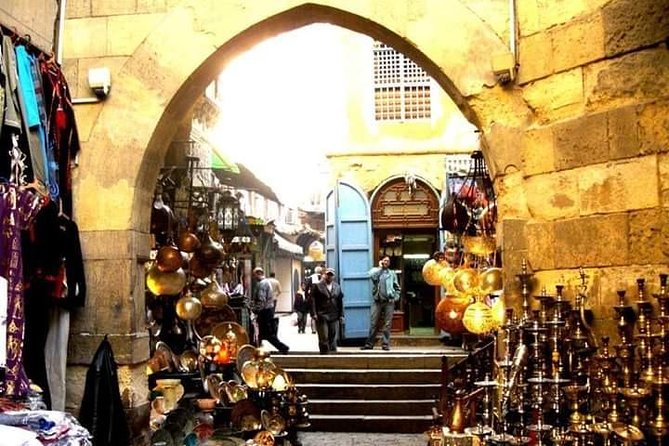
The final stop is Khan El-Khalili, the historic bazaar in Islamic Cairo. The visit lasts about an hour and gives you time to walk through the market streets, browse souvenirs, and see a commercial district that serves both local shoppers and tourists.
This is not a museum set. It is a working souk, and that means noise, sales pitches, narrow passages, and changing prices. You may find jewelry, spices, metalwork, small gifts, and Egyptian-themed souvenirs. The atmosphere is part of the experience, but you should keep your belongings close and agree on prices before buying.
I would save some Egyptian pounds for this stop if shopping interests you. The supplied comments mention small souvenir prices such as keychains and fridge magnets, but prices change and bargaining is common. Your guide can point out practical places to browse, though you should not feel pressured to purchase anything.
An hour is enough to get a taste of the bazaar. It is not enough for a slow afternoon of shopping and café sitting. If the market is a major priority, ask in advance if the timing can be adjusted, though any change depends on the operator and the rest of the schedule.
Guides, vehicles, and the private-tour advantage
The strongest part of this experience is the combination of a private vehicle and a dedicated Egyptologist guide. You are not simply being dropped at monuments. The guide is expected to explain the sites, manage the day’s movement, and help you make sense of a huge amount of Egyptian history.
Names connected with the guiding team include Ahmed, Ahmed Farahat, Mostafa, Mohammed, and Osama. Several of the supplied comments praise guides for being friendly, patient, funny, attentive, and careful with photographs. Osama is specifically associated with helping visitors find good picture locations around the pyramids. Ahmed is repeatedly connected with trip organization and personal support.
You should not assume you will receive a particular guide unless the company confirms it. Still, these details give you useful questions to ask before the tour: Who will guide us? Is the guide a licensed Egyptologist? Can the schedule be adjusted for children, older relatives, or a slower walking pace?
Private transport is provided with air conditioning and Wi-Fi. That is valuable in Cairo, where moving between attractions can be tiring. Bottled water and snacks are included, but you should still carry extra water, sun protection, and comfortable shoes.
Price, included costs, and what is extra
At $154.29 per person, the tour offers solid value if the price applies to your group size and the listed inclusions are honored. You receive two full sightseeing days, private transport, an Egyptologist guide, entrance fees for the listed sites, bottled water, snacks, Wi-Fi, and taxes.
The value is strongest for a first visit. Buying separate transport, guides, and entrance tickets could take more time and create more opportunities for confusion. A private group also gives you more control than a large shared excursion.
The price does not include personal purchases or tipping. Tipping is recommended, so budget for it separately. Extra tickets for entering the pyramids and visiting the Solar Boat Museum are also excluded.
Because this is a packed schedule, the tour is less attractive if you already know Cairo well or want long museum sessions. You are paying for coverage and convenience, not for a slow specialist experience.
Who should book this Cairo tour?
I would choose this tour for a first-time visitor with only two days in Cairo, a family that wants private transport, or a small group that prefers a guide who can explain the monuments in its own language. It also suits solo visitors who want organized sightseeing and the reassurance of a planned vehicle and guide.
It is a good match for people who want the pyramids but do not want to stop there. The route adds Saqqara and Memphis, then gives you a useful introduction to Coptic and Islamic Cairo.
I would look elsewhere if your main goal is to photograph the pyramids at a slow pace, spend half a day in the Egyptian Museum, or shop extensively in Khan El-Khalili. The schedule is broad rather than leisurely.
The tour has a five-star rating from 32 supplied reviews, with 100 percent recommending it. The most praised qualities are guide care, clear explanations, friendly service, comfortable transport, and help with planning. Those are exactly the areas that matter most on a short Cairo visit.
Final decision
Book this tour if you want Cairo’s major sights organized into two demanding but sensible days. You will see the Giza pyramids, Sphinx, Memphis, Saqqara, Egyptian Museum, Coptic Cairo, Citadel, Muhammad Ali Mosque, and Khan El-Khalili without arranging separate drivers and admissions.
Skip it if you prefer a slower schedule or want to choose every stop yourself. For most first-time visitors with limited time, though, the private format and wide range of sites make the $154.29 price a reasonable exchange for structure, transport, and local guidance.
Free cancellation is available up to 24 hours before the 8:00 a.m. start time. Changes or cancellations made later are not refunded, and poor weather may lead to a different date or a full refund.
FAQ
What is included in the two-day Cairo tour?
The tour includes a private Egyptologist guide, private air-conditioned transportation with Wi-Fi, entrance fees for the listed sights, bottled water, snacks, and taxes.
Are tickets to enter the pyramids included?
No. Extra tickets for entering the pyramids are not included in the listed price.
Is the Solar Boat Museum included?
No. The Solar Boat Museum requires an additional ticket.
What time does the tour start?
The stated start time is 8:00 a.m.
Is this a private tour?
Yes. Only your group participates in the private activity.
Can I cancel for a full refund?
Yes, if you cancel at least 24 hours before the experience start time. Cancellations or changes made less than 24 hours before the start are not refunded.
Newly listed around Cairo
- Full Day Trip from Cairo to Luxor★ 5.0 · 16 reviews
- Private guide’s trip to Giza pyramids, Great sphinx valley temple★ 5.0 · 37 reviews
- Private half Day Tour to the Great 3 Pyramids of Egypt★ 5.0 · 15 reviews
- VIP Tour inside Giza Pyramids★ 4.5 · 103 reviews
- Full-Day Private Tour to Giza Pyramids, Sphinx, Memphis & Saqqara★ 5.0 · 106 reviews
- Unique Tour to The Grand Egyptian Museum and 12 main galleries★ 4.0 · 38 reviews
- Elite Boats Tour in Cairo & Giza with Drinks Included★ 4.5 · 15 reviews
- Sunset & Night Open Air Nile Cruise in Cairo & Giza★ 5.0 · 158 reviews
2-Day Experiences, compared.
2-Day Luxor Tour with Hotel, Balloon, & Boat Ride
Read our review →
White & Black Desert tour 2 Days 1 night camping from Cairo.
Read our review →

White & Black desert camping tour 2 Days 1 night From Cairo
Read our review →
2 days cairo and giza attractions plus Gem, private tour
Read our review →
All Inclusive 2-Day Private Tour to All Pyramids and Cairo and 2 evenings
Read our review →
2-Day Top Attractions and Adventures Package in Luxor with Accommodation
Read our review →
2-Day Bahariya & White Desert Private Camp Adventure
Read our review →Browse the lists this tour appears in